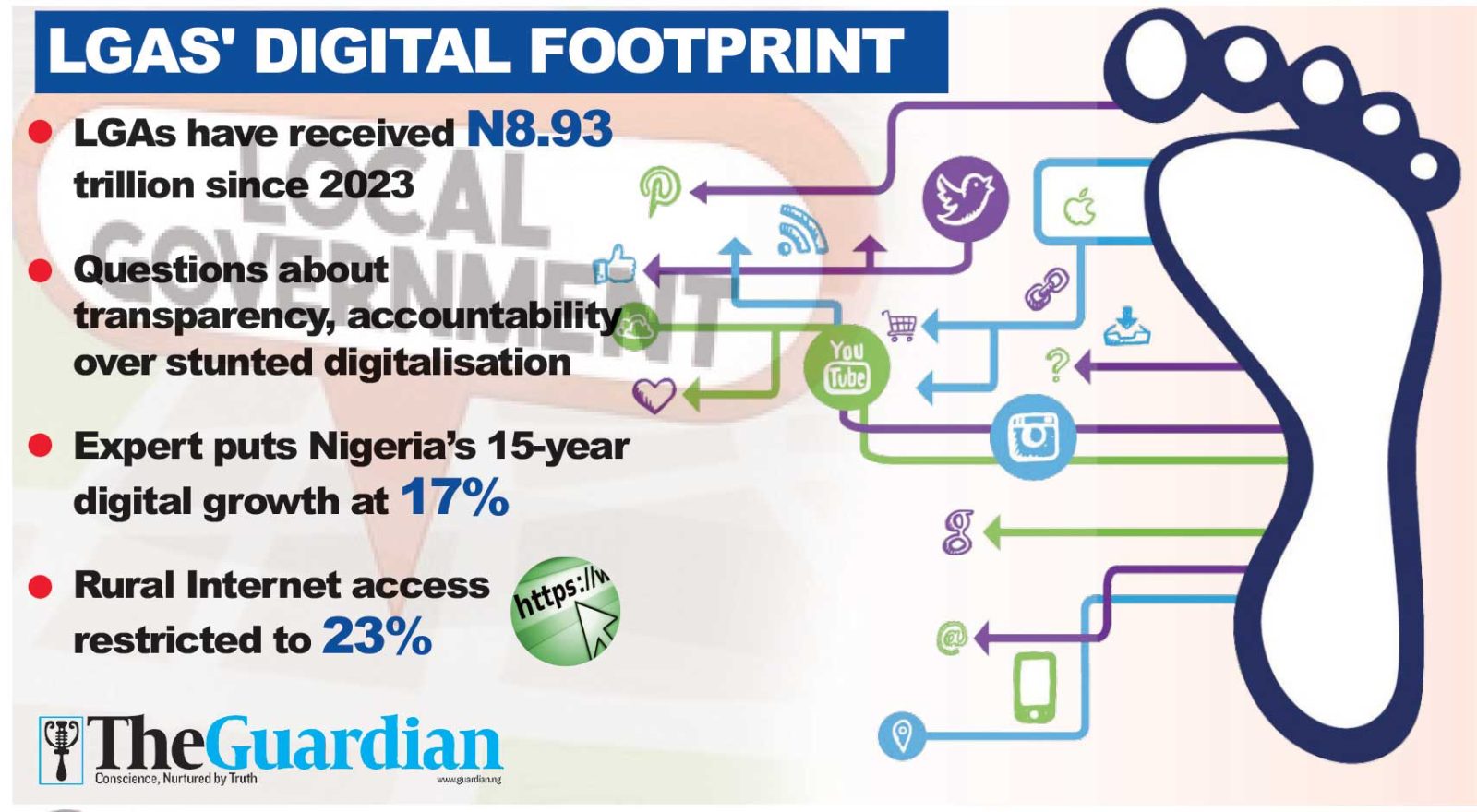
Despite receiving nearly ₦9 trillion in federal allocations between 2023 and 2025, fewer than one per cent of Nigeria’s 774 local government areas (LGAs) have functional websites, a revelation experts say exposes a serious accountability and governance failure.
Investigations show that only seven LGAs nationwide maintain active online portals, leaving 767 councils digitally invisible even after the Supreme Court granted them full financial autonomy in 2024.
Analysts describe the situation as a “digital blackout” undermining transparency and citizen engagement at the grassroots. While local governments collectively receive over ₦3 trillion yearly from the Federation Account Allocation Committee (FAAC), most operate without a single digital presence to publish budgets, projects, or procurement details.
The Independent Corrupt Practices and Other Related Offences Commission (ICPC) has confirmed the data, calling the absence of online transparency tools “a serious accountability gap.”
Experts say the problem is not a lack of resources but neglect and poor governance culture. “Maintaining a website costs a fraction of what councils earn monthly,” telecoms analyst Kehinde Aluko said. “It shows weak institutional capacity and a preference for secrecy.”
The digital vacuum also means most citizens must travel physically to council secretariats to access basic information or services, a situation worsened by poor Internet connectivity in rural areas. According to the Nigerian Communications Commission (NCC), only 23% of rural residents have Internet access compared to 57% in urban regions.
Communications and Digital Economy Minister, Dr. Bosun Tijani, acknowledged the challenge, noting that about 25 million Nigerians remain beyond reliable broadband coverage. He said the government is addressing the gap through Project 774 LG Connectivity, which aims to connect all LGA secretariats to high-speed Internet using NigComSat and Galaxy Backbone infrastructure.
So far, about 45 LGAs across eight states, including Imo, Kwara, Ogun, and Zamfara, have been connected via satellite technology, with full national coverage targeted by 2026.
However, policy experts warn that connectivity alone won’t solve the underlying governance issues. “Technology must be matched with transparency and capacity,” said innovation advisor Jide Awe. “Many councils still treat ICT as an afterthought instead of a tool for accountability and productivity.”
The Association of Telecoms Companies of Nigeria (ATCON) reports that Nigeria’s digital growth over the last 15 years stands at just 17%, with most rural councils lagging far behind.
NigComSat officials say connected LGAs are already seeing progress, including online tax payments, business registration, and real-time data collection. They believe expanding connectivity will boost transparency, attract investments, and align with Nigeria’s Digital Economy Policy and Strategy (NDEPS).
Still, with over 760 LGAs yet to establish even a basic web presence, experts fear Nigeria’s third tier of government remains trapped in opacity, digitally disconnected from the very citizens it was designed to serve.

Business
Only 7 of 774 LGAs Have Active Websites Despite ₦3tr Yearly Allocations, Experts warn of deepening transparency crisis, weak digital capacity
 News MasterUpdated 5 months Ago2 Mins read
Only 7 of 774 LGAs Have Active Websites Despite ₦3tr Yearly Allocations, Experts warn of deepening transparency crisis, weak digital capacity
News MasterUpdated 5 months Ago2 Mins read
Share





Related Articles
Business
CBN Launches Legal Challenge Against Union Bank Court Ruling
The Central Bank of Nigeria (CBN) has filed an appeal against a...
Business
Dispute Escalates Between Government and Power Firms Over Electricity Debt
The Federal Government is currently in a dispute with electricity generation companies...

Business
Delta Communities Demand Direct Involvement in Safeguarding Oil Pipelines
Leaders from oil‑producing areas of the Niger Delta have asked the Federal...
Business
Central Bank Opens Door for 100% Forex Repatriation by Oil Exporters
Nigeria’s central bank has announced a major policy shift that now allows...



Leave a comment