Despite producing over half a million graduates and an equal number of research projects annually, Nigerian universities are failing to convert academic knowledge into practical solutions for the country’s pressing challenges. IYABO LAWAL reports that with even minimal commercialisation, university research could deliver significant fiscal and societal benefits.
Charles Ayoade remembers the heat of the soldering iron and the faint ozone from his final-year project, a low-cost, decentralised solar power system designed for rural communities. Lauded as “commercially viable” by his supervisor, Ayoade envisioned clean energy for hundreds of people, job creation, and a contribution to reducing Nigeria’s crippling energy deficit.
Yet today, the prototype sits under a thick layer of dust in a locked cupboard at the University of Benin. Ayoade, now a logistics coordinator, never saw his invention reach the community it was meant to serve.
Ayoade’s story is far from unique. Across Nigeria, thousands of meticulously researched theses and prototypes each year join the “project graveyard” as graduates enter a stagnant job market while the nation battles a public debt exceeding N140 trillion.
Research without impact
Nigeria produces vast research output, yet economic hardship, unemployment, and poverty persist. Most academic work remains “dead capital,” with less than one per cent of university research commercialised. Consequently, institutions remain reliant on inadequate government funding, which in 2025 stood at just 7.07 per cent of the national budget—well below UNESCO’s recommended 15–20 per cent.
Ayoade’s experience mirrors that of Comfort Inyang, an engineering graduate from the University of Nigeria, Nsukka (UNN). Her thesis on affordable solar panels for rural villages has been shelved for three years, leaving her community’s energy challenges unresolved.
Quantity over quality
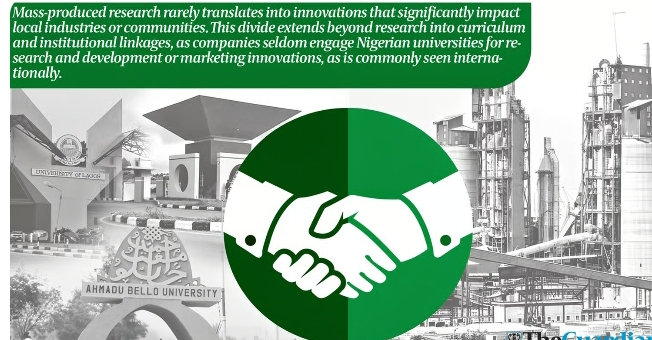
Experts say the focus in Nigerian universities is on meeting promotion benchmarks rather than solving societal problems. Final-year projects often serve only as graduation requirements. Lecturers publish to meet quotas, while companies seldom partner with universities for research and development.
Over the last decade, millions of research works have been produced, yet they have not alleviated structural problems such as unemployment, poor infrastructure, or energy deficits. The disconnect between academia and industry leaves graduates unprepared for the labour market.
Lessons from abroad
In contrast, universities in the U.S. and UK actively commercialise research. Institutions like MIT and Stanford operate technology licensing offices that translate inventions into marketable products, generating billions in revenue and thousands of start-ups.
The UK’s top universities similarly leverage intellectual property and industry partnerships, contributing over £20 billion annually to the economy. Such “entrepreneurial universities” demonstrate how research can drive innovation, employment, and wealth creation.
Bridging the gap
In Nigeria, the National Office for Technology Acquisition and Promotion (NOTAP) registers technology transfer agreements but has limited capacity to commercialise research. Experts say less than five per cent of university research makes it to the market.
Dr. Obiageli Amadiobi, current NOTAP director, emphasises active management of research commercialisation agreements to produce tangible prototypes. Meanwhile, the Federal Government has launched the National Research to Commercialisation Policy, allocating N3 billion to the initiative in 2026 and aiming to harmonise research funding for measurable impact.
Professor Babatunde Rabiu of the National Space Research and Development Agency highlights the importance of effective collaboration between universities, industry, and government to turn research into solutions. He advocates for legislation requiring companies to sponsor relevant research, with tax contributions directed to research and development.
A call to action
Experts warn that unless Nigerian universities align research with societal needs, foster industry partnerships, and increase investment in R&D, the country will continue to produce “empty” research while losing billions in potential capital.
Pockets of success exist, such as the Federal University of Technology, Akure (FUTA), and UNN’s Bioresources Development Centre (BIODEC), which have developed marketable products like biofuels and herbal medicines. However, scaling such successes across the nation remains a critical challenge for turning academic potential into national prosperity.

National
 News MasterUpdated 2 months Ago2 Mins read
Nigerian Universities Churn Out Research, But Solutions to National Challenges Gather Dust
News MasterUpdated 2 months Ago2 Mins read
Share





Related Articles

National
Herders Receive N181.9m Insurance Payout
Nigeria’s efforts to strengthen agricultural insurance and climate risk protection have recorded...

National
Tinubu Returns to Lagos After UK State Visit
President Bola Tinubu has returned to Nigeria following a two-day state visit...

National
Nigeria Intensifies Efforts to End Persistent Power Outages
The Federal Government has announced that it is taking decisive steps to...

National
“Tinubu Back in Lagos, Eyes Shift to National Development After UK Trip”
President Bola Ahmed Tinubu returned to Lagos on Friday after completing a...




Leave a comment