As debates continue over the electronic transmission of election results ahead of the 2027 general elections, Nigeria’s major telecommunications operators have dismissed claims by some lawmakers that the country lacks the infrastructure for real-time results transmission.
President Bola Tinubu, who signed the Electoral Act 2026 (Amendment) into law, emphasised that election credibility depends more on proper management and human oversight than on technology. “Final results are determined by electoral officials, not computers,” he said, adding that robust administration, rather than broadband capability, is key to ensuring free and fair elections.
Contrastingly, the Association of Licensed Telecom Operators of Nigeria (ALTON), representing MTN, Airtel, Globacom, and T2 Mobile, insisted that the objections are based on misinformation. ALTON chairman Gbenga Adebayo said Nigeria has over 70% 3G and 4G coverage, 5G in 11% of the country, and strong 2G networks capable of transmitting results electronically. He urged lawmakers to rely on verified data from the Nigerian Communications Commission rather than dismissing e-transmission outright.
While acknowledging security challenges in conflict-affected states, ALTON said such issues should be resolved collaboratively and not used to justify a nationwide rejection of technology. INEC has also maintained that results uploaded in areas with no network coverage would transmit automatically once devices connect.
House of Representatives Supports Manual Option as Safeguard
The House of Representatives defended retaining a manual transmission option, saying it is a precaution against potential technical failures. Deputy Spokesperson Philip Agbese explained that while e-transmission of Form EC8A results is mandatory, manual collation ensures elections proceed without disenfranchising voters where infrastructure may fail.
Lawmakers, including Gboyega Nasir Isiaka, argued that the decision was based on operational realities, noting Nigeria’s digital infrastructure and security vulnerabilities. They stressed that the compromise was not politically motivated but intended to protect the integrity of the process.
Security and Integrity Concerns
Former INEC Resident Electoral Commissioner Mike Igini warned that reverting to manual alternatives could endanger presiding officers at polling units, exposing them to threats when declared results contradict public expectations. He likened the system to an “Incident Form” scenario, potentially used to disrupt elections.
Conversely, civic advocate Obiageli Ezekwesili endorsed e-transmission as a tool to curb rigging and restore public trust, saying results recorded on Form EC8A and uploaded to INEC’s Result Viewing Portal would be transparent and verifiable.
Former senator Shehu Sani supported e-transmission but cautioned that technology alone cannot guarantee credible elections. He noted that electoral malpractice often stems from human conduct, such as voter inducement, rather than flaws in the transmission process. Sani stressed that the law must still allow for manual collation in areas experiencing technical failures.
The debate highlights the balancing act between embracing technology for transparency and safeguarding the electoral process in a country with varied infrastructure and security challenges.

National
 News MasterUpdated 2 hours Ago2 Mins read
Telcos Reject Claims Nigeria Can’t Handle E-Transmission of Election Results
News MasterUpdated 2 hours Ago2 Mins read
Share






Related Articles
National
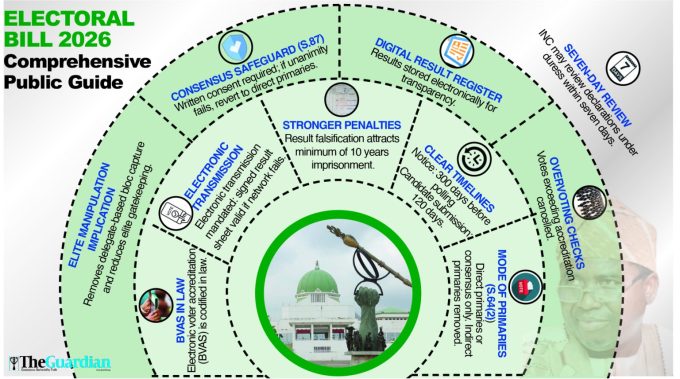
2027 Electoral Battle Shifts to INEC as Tinubu Signs Amended Electoral Act
Abuja – President Bola Tinubu’s signing of the Electoral Act (Amendment) Bill...
National
NBA Denies Alleged $2,000 Payments to SANs in Maiduguri
The Nigerian Bar Association (NBA) has refuted claims that $2,000 was given...

National
CJN Warns New Judges on Economic and Governance Implications of Their Decisions
Abuja – Chief Justice of Nigeria (CJN), Justice Kudirat Olatokunbo Kekere-Ekun, has...

National
Amotekun Condemns Alleged ‘Gestapo-Style’ Arrest of Operative by Police
The Oyo State Security Network Agency, popularly known as Amotekun Corps, has...




Leave a comment