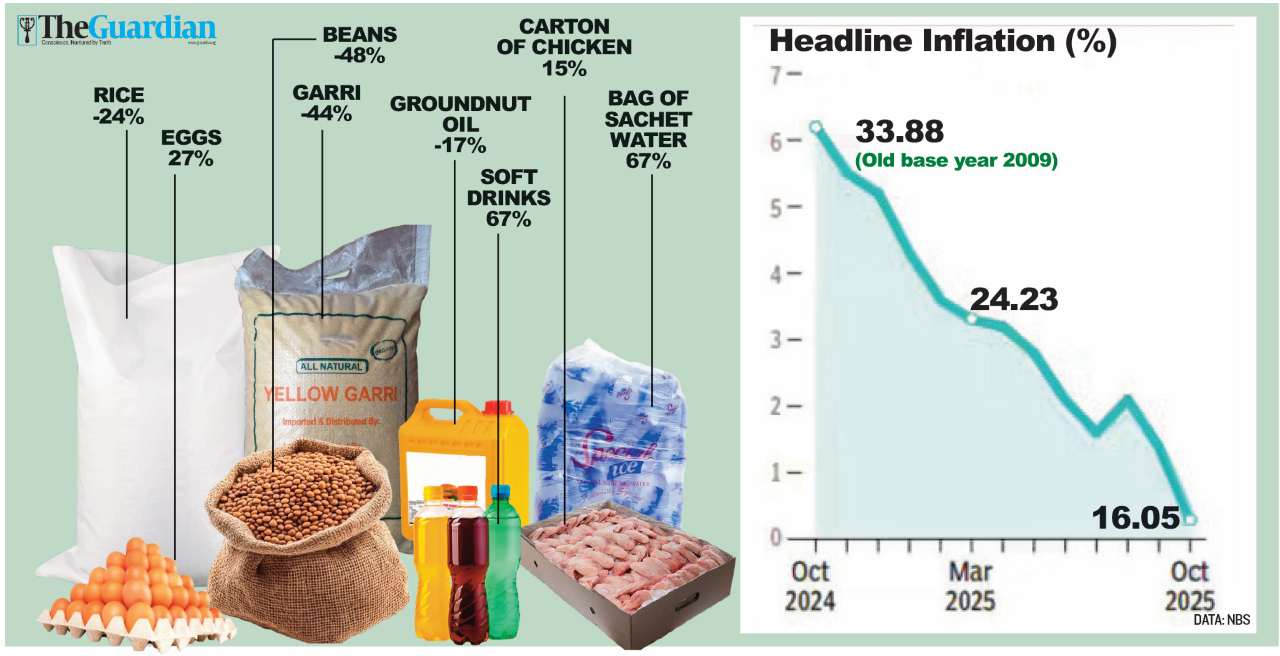
Nigeria’s inflation rate is finally showing meaningful signs of relief as falling food prices and a firmer naira continue to pull the country closer to President Bola Tinubu’s 15 per cent inflation target. The latest Consumer Price Index (CPI) reveals that inflation eased to 16.05 per cent in October, its lowest level in years, placing the government within striking distance of its year-end goal.
Although the figure marks a sharp improvement from the volatility of recent years, questions persist over whether official estimates accurately reflect the true state of market prices. Some analysts argue that inflation may have slowed even further, potentially dipping toward single digits.
Renaissance Capital Africa recently projected that inflation may have fallen to around 12 per cent in October, with a gradual move to single digits expected next year. The Central Bank of Nigeria (CBN) also maintains that disinflation is now firmly underway, a view it used to justify its recent decision to cut interest rates.
An independent survey by The Guardian, however, suggests that price movements across key markets align broadly with NBS data: most items have either declined significantly or remained relatively stable compared to last year.
—
Food Prices Fall Sharply, Some Items Enter Deflation
Food prices, traditionally the strongest driver of inflation, have tumbled dramatically:
Rice: down 24% year-on-year; a 50kg bag now sells for ₦65,000–₦75,000, compared to ₦92,000 last November.
Beans: down 48%; a 100kg bag now costs about ₦75,000.
Garri & Onions: down 40–70%.
Tomatoes & Pepper: down roughly 65%.
Other staples such as eggs have remained stable, with only slight increases seen in some noodles. In fashion and household items, key segments for middle-income earners, prices have also largely held steady.
The construction sector, however, remains mixed. While cement prices rose by 17 per cent last November during the inflation surge, the pace of increases has since slowed, and many building materials such as iron rods and electrical fittings are now flat or slightly cheaper.
A firming naira has helped moderate the cost of imports. Year-on-year, the currency has gained nearly ₦260 against the dollar, about a 15 per cent increase in value, greatly reducing import costs and strengthening overall price stability.
—
Farmers Warn of Losses as Food Prices Crash
Despite the positive inflation data, the sharp decline in food prices is already hurting farmers, many of whom report heavy losses on their 2025 investments. Stakeholders warn that continued price drops could discourage production in 2026.
Nigeria’s heavy dependence on food imports is also worsening the situation. Between April 2024 and March 2025, the country spent $2.39 billion on food imports, an 11.6% rise from the previous year, while agricultural exports generated less than $400 million.
At the last Nigeria Economic Summit, former CBN Governor and Emir of Kano, Sanusi Lamido Sanusi, warned that excessive food imports are destroying local production capacity:
> “In bringing down food prices, we wiped out the profit of producers. Farmers who borrowed heavily cannot compete. Mills are shutting down, farmers are going bankrupt, and banks are now saddled with non-performing loans.”
Farmers and industry groups echo this concern. President of the Nigeria Agribusiness Group (NABG), Kabir Ibrahim, said weak purchasing power is forcing farmers to sell below cost:
> “People simply do not have money. Farmers must lower prices just to meet their basic needs.”
—
Inflation Falls for Sixth Consecutive Month
The NBS report shows:
Headline inflation: 16.05% (down from 18.02% in September)
Food inflation: 13.12% (down from a devastating 39.16% in October 2024)
Improved harvests, a stable foreign exchange market, and lower logistics pressures have supported the trend. Analysts now expect the CBN to consider further easing after the September cut of its Monetary Policy Rate (MPR) to 27 per cent, the first reduction since 2020.
Still, persistent structural challenges, high fuel prices, elevated production costs, insecurity in food-producing regions, weak consumer demand, and infrastructure gaps, continue to weaken the impact of easing inflation on household welfare.
—
Manufacturers Struggle Amid Weak Demand
Nigeria’s manufacturing sector shows troubling signs of stagnation. The Manufacturers Association of Nigeria (MAN) recently reported that unsold inventory rose to ₦1.04 trillion in the first half of 2025, up from ₦896.2 billion in the second half of 2024. Weak government patronage and depressed household spending were identified as key drivers.
Dr Muda Yusuf, CEO of the Centre for the Promotion of Private Enterprise (CPPE), noted that while inflation is easing, households still face significant pressure in essential categories, food, transport, housing, health, education, and energy, which make up 84 per cent of Nigeria’s inflation basket.
—
Experts See Progress but Warn of Fragility
Economists say Nigeria is making progress, but the sustainability of the trend is uncertain.
Prof. Chude Nwude hailed the October numbers as “very positive,” predicting continued disinflation if monetary and fiscal discipline is maintained.
Dr Uche Olowo, former CIBN president, said the drop in food inflation suggests improving agricultural output, and believes Tinubu’s inflation target is achievable.
Patrick Ajudua, President of the NewDimension Shareholders Association, said macroeconomic indicators, including stronger naira and rising external reserves, are helping listed companies recover.
However, many experts argue that falling prices are being driven less by increased productivity than by collapsing demand, eroding incomes, and distressed producers.
—
As Nigeria inches closer to the government’s 15 per cent inflation target, the key question remains:
Is the current disinflation a sign of genuine economic recovery, or a warning signal of deeper strain across the productive sectors?

National
 News MasterUpdated 11 months Ago3 Mins read
Declining Food Prices, Stronger Naira Push Inflation Toward 15% Target
News MasterUpdated 11 months Ago3 Mins read
Share






Related Articles

National
Nigeria Moves Against South Africa Over Killing of Citizens, Demands Accountability
The Federal Government has intensified diplomatic pressure on South Africa following the...

National
Reps Approve Bill for New Federal Medical Centre in Ikwuano, Awaits Senate Approval
The House of Representatives has passed a bill sponsored by Hon. Obi...

National
FG Targets Malnutrition with New 10-Year Nutrition Policy
The Federal Government has taken a major step toward tackling malnutrition following...

National
Kalu’s Lawyers Reject Petition Seeking Revocation of Law School Certificate
Legal representatives of the Deputy Speaker of the House of Representatives, Benjamin...




Leave a comment