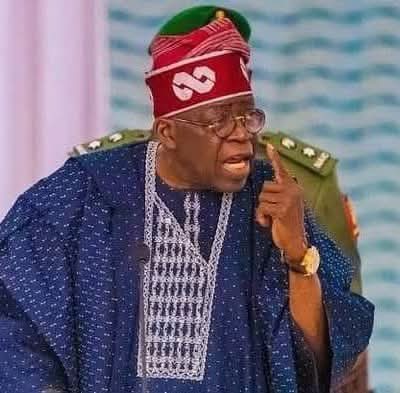
With 13 days to the end of the 2025 fiscal year, President Bola Ahmed Tinubu has asked the National Assembly to scale down the 2025 budget by more than ₦6 trillion and extend its implementation to March 31, 2026, even as he presented a ₦58.18 trillion 2026 Appropriation Bill to lawmakers.
In a letter dated December 18, 2025, and read on Friday by Speaker of the House of Representatives, Tajudeen Abbas, the president transmitted the Appropriation (Repeal and Re-Enactment) Bills for 2024 and 2025. He proposed that the 2024 budget be increased from ₦35.06 trillion to ₦43.56 trillion, while the 2025 budget be re-enacted at ₦48.32 trillion, down from ₦54.99 trillion, to reflect current fiscal realities.
Tinubu said the revised figures would cover statutory transfers, debt servicing, recurrent expenditure and capital projects, noting that the request was necessitated by revenue shortfalls and execution challenges. He also sought approval to extend the 2025 budget timeline to ensure the full release of the 30 per cent capital allocation to Ministries, Departments and Agencies (MDAs).
The move comes against the backdrop of weak revenue performance in 2025. Minister of Finance and Coordinating Minister of the Economy, Wale Edun, recently disclosed that the Federal Government generated about ₦10.7 trillion in revenue in 2025, far below the projected ₦40.8 trillion, largely due to underperformance in the oil and gas sector and other revenue heads.
Despite borrowing about ₦14.1 trillion, total inflows were insufficient to fully fund the 2025 budget, prompting the proposed downward review.
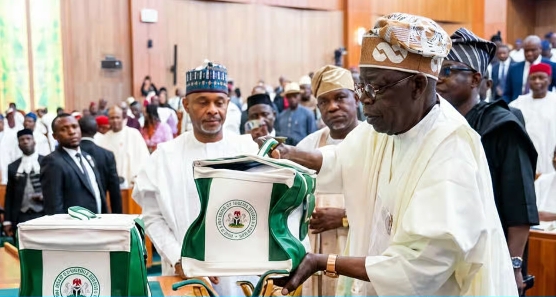
Meanwhile, addressing a joint session of the National Assembly, Tinubu presented the 2026 budget estimates titled “Budget of Consolidation, Renewed Resilience and Shared Prosperity.” He also declared that all armed non-state actors operating outside state authority would henceforth be classified as terrorists, as part of efforts to strengthen national security.
The 2026 budget proposes total expenditure of ₦58.18 trillion against projected revenue of ₦34.33 trillion, leaving a deficit of ₦23.85 trillion, representing 4.28 per cent of Gross Domestic Product. Capital expenditure is estimated at ₦26.08 trillion, recurrent non-debt spending at ₦15.25 trillion, while debt servicing is projected at ₦15.52 trillion.
Key assumptions underpinning the 2026 budget include an oil benchmark of $64.85 per barrel, production of 1.84 million barrels per day and an exchange rate of about ₦1,400 to the dollar.
Tinubu told lawmakers that Nigeria’s economy was showing signs of stabilisation, citing improved growth, easing inflation and stronger external reserves. He said the economy grew by 3.98 per cent in the third quarter of 2025, while inflation declined to 14.45 per cent in November from 24.23 per cent in March.
Security was allocated ₦5.41 trillion in the 2026 proposal, education ₦3.52 trillion, health ₦2.48 trillion and infrastructure ₦3.56 trillion. The president assured that borrowing would remain disciplined and tied to projects with measurable public value, warning that the country could no longer afford fiscal leakages and inefficiencies.
Lawmakers had earlier approved key parameters of the 2026–2028 Medium-Term Expenditure Framework, including crude oil production of 1.84 million barrels per day for 2026 and an oil price benchmark of $64.85 per barrel.
Tinubu said the repeal and re-enactment of previous budgets was aimed at ending the long-standing practice of running overlapping budgets, which he noted had complicated fiscal planning and delayed capital project execution.

National
 News MasterUpdated 9 months Ago2 Mins read
Tinubu seeks N6tr cut in 2025 budget, presents N58.18tr 2026 estimates
News MasterUpdated 9 months Ago2 Mins read
Share



Related Articles
National
Nigeria Moves Against South Africa Over Killing of Citizens, Demands Accountability
The Federal Government has intensified diplomatic pressure on South Africa following the...
National
Reps Approve Bill for New Federal Medical Centre in Ikwuano, Awaits Senate Approval
The House of Representatives has passed a bill sponsored by Hon. Obi...
National
FG Targets Malnutrition with New 10-Year Nutrition Policy
The Federal Government has taken a major step toward tackling malnutrition following...

National
Kalu’s Lawyers Reject Petition Seeking Revocation of Law School Certificate
Legal representatives of the Deputy Speaker of the House of Representatives, Benjamin...



Leave a comment