An apparently minor omission at an All Progressives Congress (APC) event in Maiduguri has ignited intense political speculation, exposing deepening fault lines within the ruling party ahead of the 2027 general election.
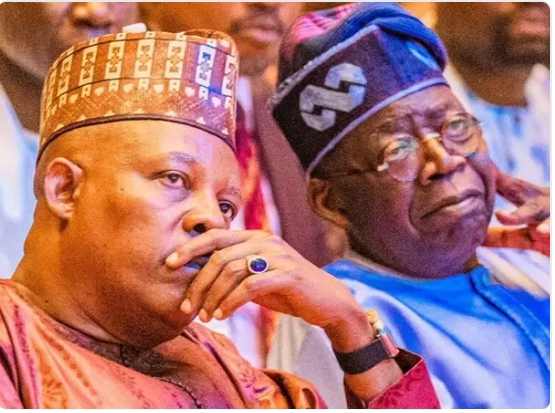
The incident occurred during the APC North-East Zonal Public Hearing, where a large banner behind the podium displayed images of President Bola Ahmed Tinubu, governors from the zone and senior party leaders. Conspicuously absent, however, was Vice President Kashim Shettima — a native of Borno State, former governor and the most senior APC figure from the North-East.
The omission did not go unnoticed.
Abdulkarim Lawan, Speaker of the Borno State House of Assembly and Nigeria’s longest-serving speaker, openly questioned the absence while addressing the gathering.
“Why is the Vice President’s photograph missing from the banner?” he asked, drawing loud applause from the audience.
What might ordinarily have been dismissed as a design error quickly assumed political significance, especially given growing speculation within the APC about Shettima’s future on the party’s 2027 presidential ticket.
A Pattern That Raises Questions
This was not the first time Shettima’s image had been excluded from a major APC event in the North-East. A similar incident at a party gathering in Gombe State last year reportedly led to disruptions.
However, the Maiduguri omission struck a deeper chord. It occurred in Shettima’s home state and at a time when political alignments for 2027 are quietly taking shape across the country.
Within the APC, rumours have intensified that President Tinubu may consider dropping Shettima as his running mate, amid renewed debates over religious balancing and the viability of another Muslim–Muslim ticket.
For many party members, the missing image appeared to give visible expression to what had previously been confined to political whispers.
Warnings from Within the APC
Reacting to the speculation, Abayomi Nurain Mumuni, an APC chieftain and security expert who served on the intelligence and security team of the Tinubu–Shettima Presidential Campaign Council in 2023, cautioned against replacing the Vice President.
Mumuni warned that altering the ticket on religious grounds would be a risky political gamble, arguing that the North currently lacks a Christian candidate with comparable political structure, grassroots support and national appeal to offset Shettima’s electoral value.
He noted that Shettima’s loyalty and consistency remain critical stabilising factors within the party and government, adding that tampering with a winning ticket could undermine internal unity and weaken the APC’s prospects in 2027.
North-East Resistance Grows
Across the North-East, talk of dropping Shettima has been met with strong resistance. The APC Youth Parliament described the rumours as divisive and potentially destructive.
Its chairman, Kabiru Garba Kobi, warned that removing Shettima could cost President Tinubu significant political support in the region. He described the Vice President as the most unifying political figure in the North-East and a crucial link between the zone and the presidency.
Kobi cautioned party leaders against yielding to what he termed opportunistic voices that neither contributed meaningfully to the APC’s 2023 victory nor demonstrated sustained loyalty to the party.
External Pressure and Internal Sensitivities
Behind the scenes, sources within the Presidency acknowledge rising concern over international scrutiny, particularly from the United States, regarding Nigeria’s religious balance. Recent comments by U.S. President Donald Trump on alleged persecution of Christians in Nigeria have further intensified internal debates.
While some APC figures argue that Nigeria’s security and defence leadership already reflects religious diversity, others strongly reject the idea that foreign expectations should influence Nigeria’s electoral choices.
This dynamic has further complicated internal party calculations, blurring the line between domestic political strategy and external pressure.
North-Central Distances Itself
Amid claims that the North-Central zone is lobbying for a Christian vice-presidential slot, the North-Central APC Forum issued a firm denial. The group said it is not seeking the vice-presidency and is instead focused on contesting the presidency in 2031.
The forum warned that dropping Shettima would amount to a serious political miscalculation that could shrink Tinubu’s support base and hand the opposition an advantage in 2027.
Diverging Public Opinions
Political commentators remain sharply divided.
Former presidential spokesperson and journalist Reuben Abati described the speculation as “a potentially disruptive kite being flown,” warning that it could strain the relationship between the President and Vice President as political activities ahead of 2027 intensify.
Others, however, believe a change is inevitable. Prof. Olusore Afuye argued that a Muslim–Muslim ticket may not be politically sustainable in 2027, while political commentator Engr. Arinze Cajet claimed that internal party issues, rather than religion, may already have sealed Shettima’s fate.
Silence from the Vice President
Vice President Kashim Shettima has so far remained silent, neither addressing the banner incident nor responding to the growing rumours about his political future.
In Nigerian politics, such silence is often interpreted as strategic restraint rather than indifference.
What began as a missing photograph in Maiduguri has evolved into a broader test of loyalty, power and political calculation within the APC. As 2027 draws closer, the ruling party faces a critical decision: whether changing a familiar political equation will secure its future or unravel it.

Politics
 News MasterUpdated 8 months Ago3 Mins read
2027: APC Tensions Deepen as Shettima’s Political Future Sparks Division
News MasterUpdated 8 months Ago3 Mins read
Share




Related Articles

Politics
ORU WEST DESERVES BETTER, NO COMMUNITY WILL BE LEFT BEHIND — DCN OBIOMA OKORIE
Hon. Deacon Obioma Okorie, aspirant for Oru West State Constituency for the...
Politics
Abia’s Future in Focus: Mascot Uzor Kalu Emerges Voice of Reason Amid Abia APC Political Tension
“In the end, peace is not merely the absence of conflict, but...
Politics
Abia’s Future in Focus: Mascot Uzor Kalu Emerges Voice of Reason Amid Abia APC Political Tension
“In the end, peace is not merely the absence of conflict, but...
Politics
ADC Faces Crucial Test as Supreme Court Ruling Looms Over 2027 Ambitions
The African Democratic Congress (ADC) is at a defining crossroads as the...




Leave a comment