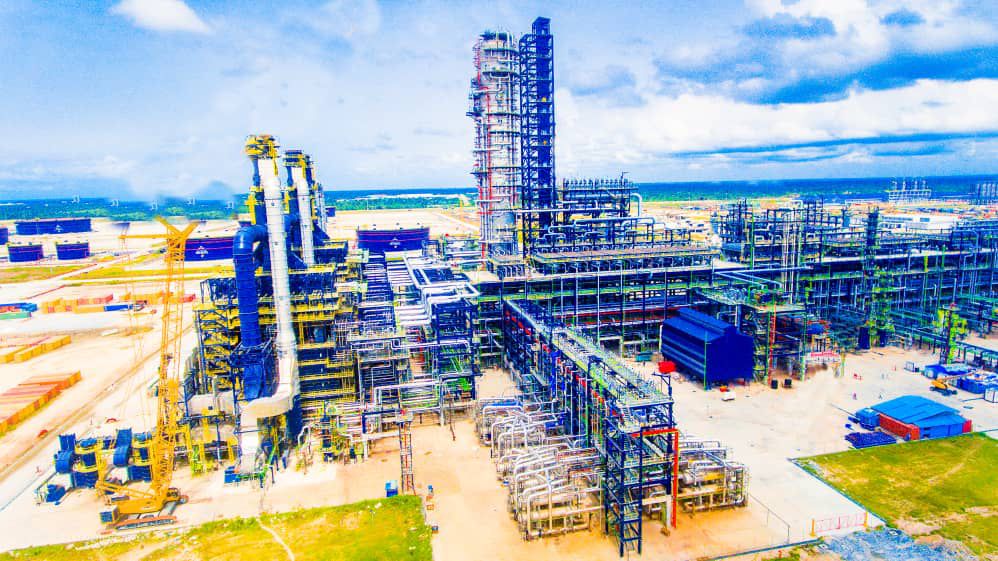
The Chief Executive Officer of Dangote Refinery and Petrochemical Company, David Bird, has revealed that the $20 billion facility is scaling up its storage, logistics and maritime infrastructure, with plans to receive about 600 vessels annually as operations reach full capacity.
Bird said the refinery’s coastal location and deep-sea access were deliberately designed to support efficient import and export activities. Unlike conventional refineries connected to a single crude pipeline, he explained that the Dangote Refinery operates a merchant model that relies heavily on maritime operations.
Speaking to members of the Maritime Correspondents’ Organisation of Nigeria (MARCON) during a tour of the facility on Tuesday, Bird noted that the refinery’s port is expected to handle approximately 600 vessels yearly as production ramps up.
He said the anticipated vessel traffic would generate significant economic benefits, including job creation, local content development and logistics growth.
On the possibility of venturing fully into shipping, Bird disclosed that Dangote Industries is working towards gaining greater control of its supply chain. He said the company has moved from sourcing vessels on the open market to time-chartering ships, adding that outright vessel acquisition remains part of its long-term strategy once cash flow stabilises.
“It is a no-brainer to control your supply chain,” Bird said, citing recent vessel-related disruptions as justification for deeper involvement in shipping.
He also linked the strategy to Dangote’s broader Pan-African expansion plans, including a proposed tank farm in Namibia and ongoing engagements in Cameroon and Ghana, aimed at securing reliable distribution outlets across the continent.
Bird further clarified that the refinery operates on a global merchant model similar to facilities in Rotterdam and Singapore. In this system, crude oil feedstock is sourced from multiple countries and transported by sea, while refined products are distributed both locally and internationally through maritime channels.
“This is not a refinery sitting at the end of a crude pipeline. All of our feedstock is imported by sea, and our products can go into Nigeria or be exported globally. That is the standard merchant refinery model,” he said.
Providing additional insights, an engineer in the Maintenance Planning Department, Victor Ngangha Oyama, explained that the Dangote Port—initially constructed as a jetty to receive specialised equipment during the refinery’s construction—has been transformed into a fully operational import and export hub.
According to Oyama, the port currently handles fertiliser exports to countries including Brazil, receives raw materials, and is undergoing further expansion to accommodate increased vessel traffic as operations scale up.
Also speaking, the Head of Marine, Petroleum and Petrochemical, Captain Satendra Singh Rana, detailed the refinery’s offshore marine infrastructure. He said the facility operates five Single Point Mooring (SPM) buoys offshore—two for crude oil and three for refined products—connected by 48-inch pipelines buried two metres beneath the seabed for safety.
Rana disclosed that the crude SPMs can berth some of the world’s largest tankers, including Very Large Crude Carriers (VLCCs) with capacities of up to two million barrels, while some shipments have reached three million barrels.
He added that the system is designed for quick turnaround, with most vessels discharged within 24 hours and larger tankers within 36 hours. So far, the facility has handled about 800 tankers, a milestone he described as remarkable for a new refinery-terminal operation.
“With the refinery ramping up to 650,000 barrels per day, we expect around 600 tankers annually, covering both crude imports and product exports,” Rana said.
He noted that the offshore configuration takes advantage of natural water depths of up to 40 metres for crude and 20 metres for products, eliminating the need for expensive maintenance dredging.
Rana also stated that the SPM and telemetry systems were designed and manufactured by a Houston-based company in the United States, describing them as among the highest-rated and safest technologies in global maritime energy trade.

Business
 News MasterUpdated 7 months Ago2 Mins read
Dangote Refinery Targets 600 Vessels Annually as Operations Expand
News MasterUpdated 7 months Ago2 Mins read
Share






Related Articles
Business
Hon. Amobi Ogah Engages Global Stakeholders at OTC Texas As Nigeria’s Energy Future Comes in Focus
U.S., Texas — Nigeria’s push for innovation and global collaboration in the...
Business
Fear of Oil Glut as NNPCL Raises Crude Prices Across Grades
Concerns are growing over a possible global oil glut as the Nigerian...
Business
Aliko Dangote’s Wealth Climbs to $34bn After $216m Single-Day Surge
Africa’s richest man, Aliko Dangote, has seen his net worth rise to...
Business
Nigeria’s Petrol Price Drops 15.6% Year-on-Year – NBS
The average retail price of petrol in Nigeria declined by 15.6 per...




Leave a comment