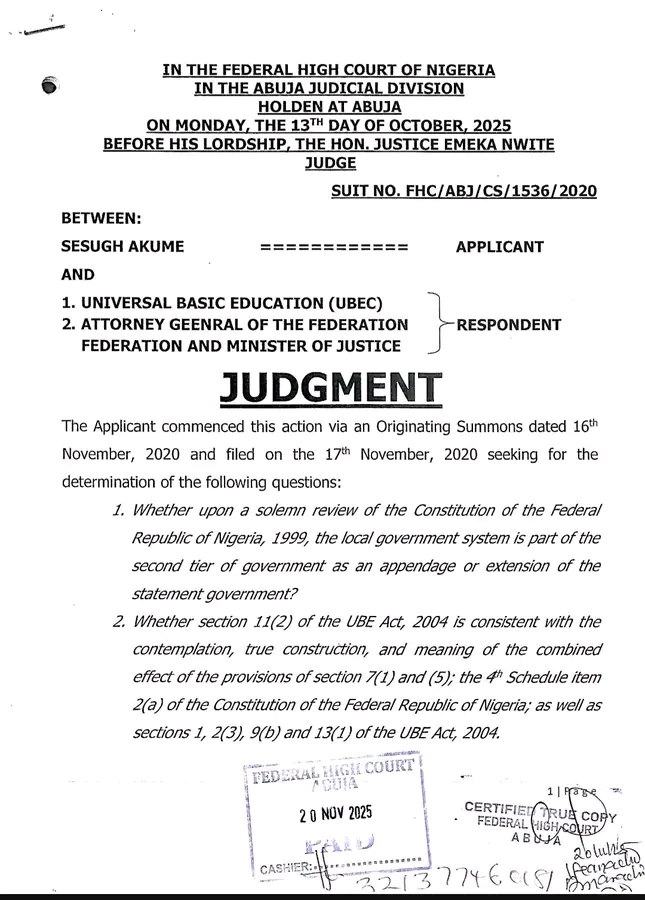
The Federal High Court in Abuja has delivered a historic ruling confirming the constitutional independence of local governments and striking down parts of the Universal Basic Education (UBE) Act, 2004, that placed them under state oversight.
Justice Emeka Nwite, in a judgment delivered on October 13, 2025, emphasized that local governments are autonomous entities established by the 1999 Constitution and not subordinate to state governments.
The court nullified sections of the UBE Act that required Local Government Education Authorities (LGEAs) to operate under State Universal Basic Education Boards (SUBEBs), ruling that such arrangements are inconsistent with the Constitution.
The judgment instructs the Universal Basic Education Commission (UBEC) and the Attorney-General of the Federation to formally notify all 37 SUBEBs and 774 LGEAs nationwide of the decision within three months. LGEAs are now permitted to apply for and receive federal education funds directly from UBEC without state interference.
The case, filed by Sesugh Akume against UBEC and the Attorney-General of the Federation, challenged the constitutionality of provisions mandating the administration of federal education funds through SUBEBs. The court found Sections 11(3) and 13(1) of the UBE Act incompatible with Sections 7(1), 7(5), and Item 2(a) of the Fourth Schedule of the Constitution.
“The local government system is the third and autonomous tier of government,” Justice Nwite declared, stressing that any law placing local governments under state control is unconstitutional.
The ruling also requires LGEAs to fulfill their counterpart funding obligations and access UBE grants independently, ending the longstanding practice of SUBEBs managing local government education funds—a system often criticized for delays, diversion of funds, and underfunding at the grassroots level.
UBEC has reported that hundreds of billions of naira in UBE intervention funds remain unutilized, while millions of Nigerian children continue to be out of school, and many primary and junior secondary schools lack teachers, classrooms, and essential learning materials.
The court set January 14, 2026, as the deadline for UBEC and the Attorney-General to notify all SUBEBs and LGEAs of the judgment. Legal analysts believe the ruling will significantly improve local government autonomy, education funding, and accountability across Nigeria.

Featured
 News MasterUpdated 9 months Ago1 Mins read
Court Declares Local Governments Fully Autonomous, Mandates Direct Access to Federal Education Funds
News MasterUpdated 9 months Ago1 Mins read
Share




Related Articles
Featured
ARTICLE: Service Beyond the Ballot: Chief Mascot Uzor Kalu’s Enduring Commitment to the People
Leadership is not defined solely by electoral victory or the office one...
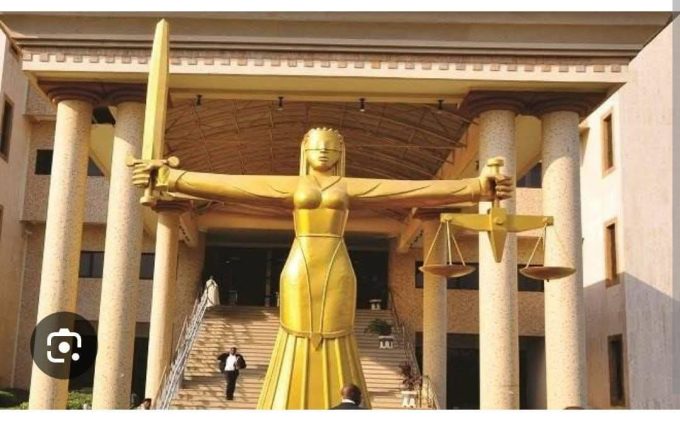
Featured
Supreme Court Set to Rule on PDP and ADC Leadership Disputes Today
Nigeria’s political landscape is on edge as the Supreme Court prepares to...
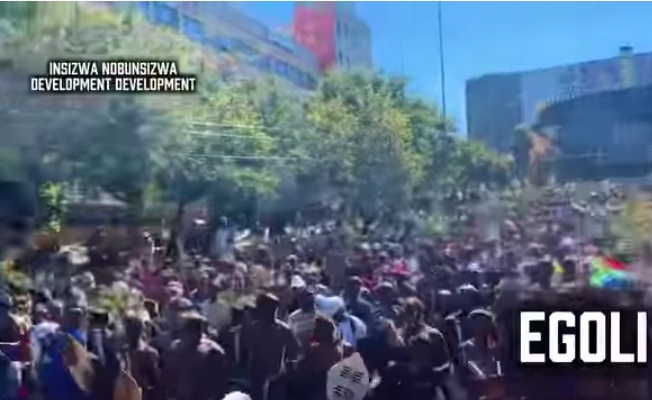
Featured
Mass Demonstrations in South Africa Highlight Rising Tensions Over Foreign Nationals
Large-scale demonstrations broke out across several major cities in South Africa as...

Featured
Article: Fixing Nigeria Starts with Fixing the States by Dr Uche Ogah
By Uche Ogah Nigeria’s development challenge is not merely a national dilemma....



Leave a comment