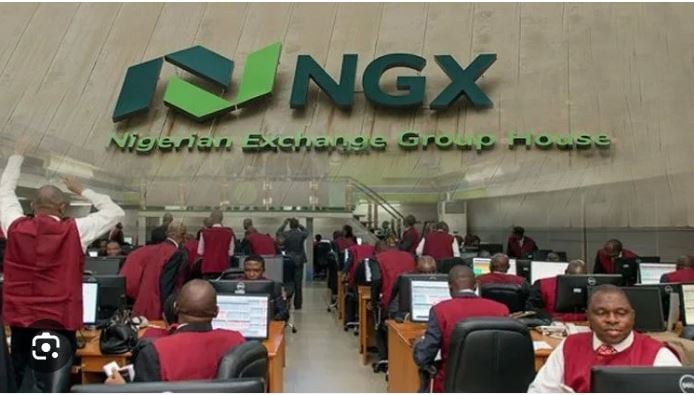
The Nigerian equities market started the week on a negative note, with the All-Share Index (ASI) falling 1.26% to close at 145,159.77 points on Monday. The decline erased approximately N1.17 trillion from investors’ wealth, bringing total market capitalization down to N92.3 trillion.
Market data showed that the slump was largely driven by heavy selling in Dangote Cement, which dropped by 10%, alongside losses in top-tier banks such as Zenith Bank (-1.64%), Access Holdings (-3.26%), and FBN Holdings (-2.76%).
Despite the overall decline, market breadth remained slightly positive, with 28 gainers outpacing 24 losers. Sovereign Insurance led the gainers with a 9.97% rise, while Dangote Cement and Enamelware, both down 10%, topped the losers’ chart.
Trading activity normalized after last Friday’s unusually high turnover, which had been fueled by off-market crosses in Cornerstone Insurance. Total volume traded fell sharply by 92.1% to 388.2 million units, and total value traded dropped by 26.3% to N31.1 billion. Tantalizer emerged as the most traded stock by volume, moving 57.1 million units, while Aradel Holdings dominated by value, accounting for N21.5 billion—or 69% of total market value. Notably, Tantalizer recently announced a five-year multi-million-dollar export deal for premium prawns and shrimps with a U.S.-based firm.
Sector performance was largely bearish. The Industrial Goods Index led losses, down 4.48% due to weakness in Dangote Cement. The Oil & Gas Index slipped 1.18% on declines in Oando and Aradel, while the Banking Index fell 1.01%. The Consumer Goods Index edged lower by 0.02%. Conversely, the Insurance Index recorded modest gains, rising 0.07% thanks to Sovereign Insurance.
Cowry Asset Management attributed Monday’s downturn to profit-taking among investors. The firm noted that the market capitalization decline occurred despite the listing of 1.96 billion ordinary shares of Chams Holdings through a private placement, highlighting the intensity of sell pressure.
Cowry further observed that trading patterns pointed to increased retail activity. Total trading volume fell 92.64% to 360.6 million units and value dropped 26.88% to N30.9 billion, yet the number of deals rose 15.83% to 27,975, indicating participation through smaller-sized trades.
Meanwhile, the National Bureau of Statistics reported that Nigeria’s inflation continued to moderate in October, easing to 16.1% year-on-year from 18.0% in September. Both food and core inflation slowed to 13.1% YoY and 18.7% YoY, respectively, compared to 16.9% and 19.5% in the previous month. However, month-on-month, headline inflation increased by 0.9%, up from 0.7% in September.

Business
 News MasterUpdated 3 months Ago1 Mins read
Market Loses N1.17tn as Dangote Cement, Banks Weigh on Nigerian Equities
News MasterUpdated 3 months Ago1 Mins read
Share






Related Articles

Business
Customs Transfers Nearly 160,000 Litres of Confiscated Petrol to Regulatory Authority
A large volume of petrol intercepted during anti-smuggling operations has been formally...

Business
Music Rights Body Accuses Malami of Orchestrating Billion-Naira Levy Scam
The Copyright Society of Nigeria (COSON) has voiced serious concerns over what...

Business
Naira Rockets to Two-Year High as Market Gains Momentum
The Nigerian naira has surged to its highest level in nearly two...
Business
Investors Fret as Oil Surges Amid US-Iran Tensions
Global financial markets weakened this week as mounting tensions between the United...




Leave a comment