
Despite Nigeria’s strained economy and rising cost of living, the Federal Government’s 2026 budget proposal reveals heavy spending on luxury vehicles, office maintenance, and loosely defined “miscellaneous” expenses, raising serious concerns about fiscal discipline and governance priorities.
Details released by the Budget Office show that while government officials continue to urge citizens to make sacrifices, hundreds of billions of naira are being allocated to items that do little to improve economic productivity or infrastructure. These include vehicle purchases, office renovations, stationery, and discretionary expenses that reflect elite comfort rather than national recovery.
N17 Billion for ‘Miscellaneous’ Spending
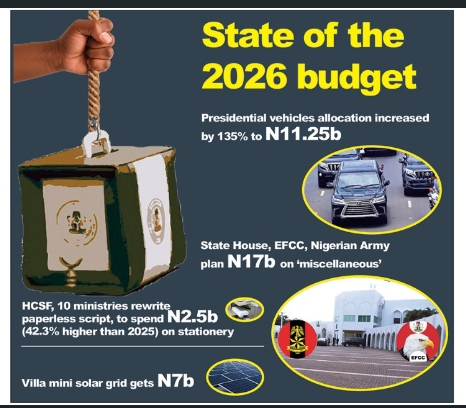
Three major institutions, the State House Headquarters, the Nigerian Army, and the Economic and Financial Crimes Commission (EFCC), are collectively budgeting N16.78 billion under the vague category of “miscellaneous.”
The Nigerian Army alone will spend N10.52 billion, while the EFCC and the State House will spend N3.09 billion and N3.17 billion respectively. The Nigerian Navy has also set aside over N1 billion for similar purposes.
While defence agencies may require confidential spending, the trend has spread to civilian institutions. Diplomatic missions, the Bureau of Public Procurement (N300 million), NEITI (N584 million), Defence Missions (N1.86 billion), and the Ministry of Foreign Affairs (N1.14 billion) have all budgeted large sums under miscellaneous expenses, raising transparency concerns.
Presidential Vehicle Budget Jumps by 135%
Spending on presidential vehicles has skyrocketed from under N5 billion last year to N11.25 billion in 2026, a 135 per cent increase, even as many Nigerians struggle to afford basic necessities.
This sharp rise has drawn criticism, especially in a year when economic reforms have pushed food, transport, and energy costs beyond the reach of many households.
Paperless Policy, Paper Spending Soars
Ironically, the government’s push for digitalisation has not reduced stationery spending. Instead, costs have risen sharply.
The Head of the Civil Service of the Federation (HCSF) and 10 ministries will spend N2.46 billion on stationery and office materials in 2026, 42.3% higher than last year.
This comes despite the launch of the 1Gov Enterprise Content Management System (ECMS), which was designed to make the public service paperless. By the end of 2025, all ministries were reportedly operating digitally, with physical files no longer accepted.
Yet the HCSF alone will spend N300.88 million on stationery this year, N101 million more than in 2025. The Ministry of Defence raised its stationery budget by 82%, while the Ministry of Justice increased its allocation from N125 million to N525 million. Only the Ministry of Women Affairs reduced its stationery spending.
Overall, Nigeria’s public sector is estimated to spend about N50 billion annually on paper and office supplies a cost many private organisations have eliminated through digital tools.
State House Spending Remains Massive
Between 2024 and 2026, the State House Headquarters has received N17.74 billion for vehicle purchases and N36 billion for building repairs and maintenance.
In 2026 alone, it will receive:
- N11.23 billion for vehicles
- N8.48 billion for building maintenance
- N3.84 billion for repairing the Presidential Villa
- N1.28 billion for office complexes
- N7 billion for a mini solar power grid
These repeated repair allocations have raised concerns over contract inflation and weak oversight.
Agencies Used for Political Projects
The 2026 budget also shows government agencies being used to fund projects unrelated to their core mandates. For instance, the Centre for Management Development will spend N1.4 billion on trucks and empowerment items for selected political districts, turning a training institution into a tool for political patronage.
A Budget of Comfort, Not Reform
Although the overall budget of the presidency fell slightly from 2025, spending on luxury assets, maintenance, and discretionary projects remains high.
Experts warn that this pattern undermines President Bola Tinubu’s promise of fiscal discipline, transparency, and accountability, turning the national budget into a tool of elite comfort rather than economic recovery.
With revenue uncertainty, mounting debt, and widespread hardship, critics say Nigeria cannot afford a budget that prioritises luxury over development.






Leave a comment