

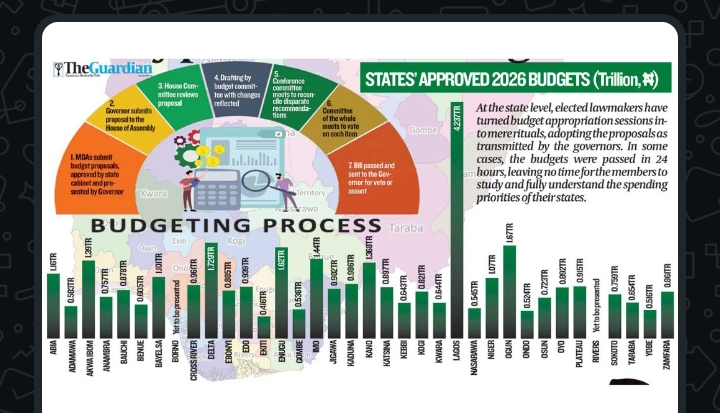
Nigeria’s 2026 budget cycle has raised serious concerns over the erosion of legislative oversight, as many state Houses of Assembly hurriedly passed multi-trillion-naira spending plans with little scrutiny, often returning figures exactly as submitted by governors.
Across all geopolitical zones, the pattern is strikingly similar: governors presenting budgets late in the year, lawmakers approving them within days, sometimes within 24 hours, and executives signing them into law almost unchanged. Analysts warn that the trend undermines constitutional checks and balances and weakens the credibility of public finance management.
In Imo State, lawmakers passed a ₦1.44 trillion budget less than 24 hours after presentation. In Edo, Ekiti and Enugu, appropriation bills were returned untouched. Enugu’s ₦1.62 trillion budget, presented December 2, was passed by December 18 and signed into law December 24. Meanwhile, Rivers and Borno are yet to present their estimates amid ongoing political and administrative situations.
Overall, 34 states have proposed spending ₦34.63 trillion in 2026 about 54.4 per cent higher than the ₦22 trillion approved collectively for 2025. On average, each state plans to spend ₦1.02 trillion next year, compared to ₦611 billion this year. This comes despite reports of poor budget performance, particularly in capital projects that directly impact citizens, many of which struggle to reach even 50 per cent execution.
Observers note that most state budgets were stalled while awaiting the Federal Government’s fiscal direction, only to be rushed through in December to meet calendar expectations. Critics say state legislatures have increasingly surrendered their independence, becoming rubber stamps in a process that should demand rigorous review and defence of public interest.
This mirrors the situation at the federal level, where the Medium-Term Expenditure Framework (MTEF), the statutory backbone of the national budget arrived months late, yet was passed within days. The 2026 Appropriation Bill of ₦58 trillion has equally faced allegations of rushed legislative handling, with lawmakers accused of prioritising speed over scrutiny.
Chairman of the Senate Appropriations Committee, Adeola Olamilekan, recently admitted confusion over shifting budget figures, while Senate Leader Opeyemi Bamidele maintained that the spending plan remains focused on consolidation, infrastructure and development. Still, analysts insist credibility is at stake when fiscal documents shift mid-process.
At the House of Representatives, lawmakers repealed and re-enacted the 2024 and 2025 Appropriation Acts while extending the 2025 budget to March 31, 2026—a move the House said was designed to restore order to Nigeria’s fiscal calendar. Deputy House Spokesperson Philip Agbese argued that the step would eventually lead to a single, predictable national budget cycle.
Yet experts like BudgIT’s Seun Onigbinde argue that Nigeria effectively runs “a budgeting system without a calendar,” warning that erratic timelines weaken planning, delay projects and deepen distrust in governance.
State-level examples reinforce these fears. Delta passed its ₦1.72 trillion budget within weeks. Bayelsa and Cross River also completed processes swiftly, while Edo processed its ₦939.85 billion plan in record time, with no major adjustments. In the South-West, Oyo approved ₦892 billion after just weeks of deliberation, while Ondo lawmakers even added ₦31.6 billion to the governor’s proposal before passage.
Former CBN Deputy Director Bashorun Olorunfunmi noted that groundwork often happens before formal presentation but stressed that what truly matters is how lawmakers monitor implementation. Former Lagos Assembly aide Lanre Odubote added that while no law mandates how long budget passage must take, late executive submissions contribute to hurried approvals.
Despite these explanations, concerns persist that legislative complacency is producing unrealistic revenue projections, weak execution and widening governance gaps. With many states failing to meet even 60 per cent budget performance in recent years—and capital spending frequently lagging, citizens and analysts fear the sanctity of public budgeting is gradually being eroded.
As Nigeria prepares for 2026, stakeholders insist the challenge is no longer just about passing budgets on time, but about restoring integrity, accountability and genuine legislative oversight in a system many now describe as merely fulfilling ritual obligations rather than driving development.






Leave a comment