For decades, successive Nigerian governments have pledged to build a strong and competitive industrial economy. Yet, despite the central role of manufacturing in job creation, economic diversification and export growth, the sector’s performance continues to tell a different story. Persistent decline, weak capacity utilisation and shrinking contribution to GDP have led many stakeholders to conclude that official commitments to manufacturing remain largely rhetorical.
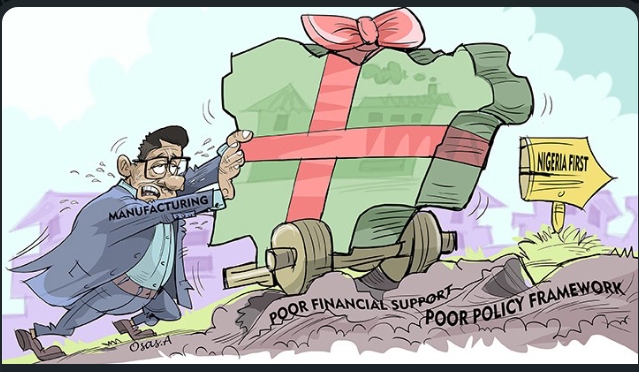
This reality has cast doubt on the effectiveness of the “Nigeria First” policy introduced by President Bola Tinubu’s administration, as well as two executive orders signed under the previous government to boost local production. Despite bold pronouncements, industry players say the policies have delivered little measurable impact on the economy.
Manufacturing Still Underperforming
Although manufacturing is widely regarded as the backbone of industrialisation, Nigeria’s sector has struggled to realise its potential due to what stakeholders describe as insufficient political will and weak policy implementation. Data from the Manufacturers Association of Nigeria (MAN) show that the sector operates at less than 50 per cent of installed capacity, reflecting years of neglect and inconsistent government support.
This underperformance has been mirrored in the sector’s declining contribution to GDP. Quarterly figures reveal year-on-year drops in manufacturing output and value addition, underscoring deep structural challenges.
A KPMG report released in the third quarter of 2025 paints a similar picture. It showed that manufacturing growth remained sluggish, posting a modest 1.38 per cent growth in 2024. Over the past five years, average growth stood at just 1.17 per cent, with post-COVID gains in 2021 quickly tapering off. Manufacturing’s share of GDP fell from 9.2 per cent in 2018 to 8.6 per cent in 2024, while the sector’s share of total exports dropped sharply from 10.8 per cent in 2019 to 2.2 per cent in 2023.
Although manufacturing export value rose by 194 per cent in 2024, from ₦778.4 billion in 2023 to ₦2.29 trillion, the sector still accounted for only about three per cent of total exports, reflecting stronger growth in other areas of the economy. Nigeria’s five-year average manufacturing export ratio of 4.2 per cent lags far behind peers such as Botswana (92.9 per cent), Egypt (46.8 per cent), South Africa (39 per cent) and Ghana (6.4 per cent).
Policies Without Teeth
Industry observers attribute the sector’s poor showing to inconsistent policy frameworks, limited access to finance and the absence of targeted, enforceable interventions. While governments have repeatedly announced initiatives to support manufacturing, implementation has remained weak.
Under the Buhari administration, two executive orders, Executive Orders 003 and 005, were introduced to promote local production. Executive Order 003, signed in May 2017, mandated Ministries, Departments and Agencies (MDAs) to prioritise locally manufactured goods and services in public procurement, with at least 40 per cent of spending on listed items to be sourced locally.
Executive Order 005, signed in February 2018, focused on building indigenous capacity in science, technology and engineering to drive innovation and competitiveness.
Despite these measures, enforcement remained poor, and their impact limited.
In May 2025, the Tinubu administration introduced the “Nigeria First” policy, promising to consolidate previous efforts through a new executive order that prioritises Nigerian-made goods across government agencies. The Minister of Information and National Orientation, Mohammed Idris, said no MDA would be allowed to procure foreign goods where local alternatives exist, except with approval from the Bureau of Public Procurement (BPP).
He added that procurement rules would be updated, credible local suppliers identified, and sanctions imposed on defaulting officers. According to Idris, the policy is intended to reduce imports, retain public spending within the country and strengthen the local economy.
Familiar Promises, Familiar Problems
However, industry leaders argue that the policy is not new and that enforcement has always been the weak link. The Director-General of the Textile Manufacturers Association of Nigeria (TMAN), Dr. Gamma Kwajaffa, recalled a similar directive in 2017 that required civil servants to wear Made-in-Nigeria attire on specific days.
“In practice, there was no serious enforcement,” he said. “Most procurement officers did not cooperate, and government agencies largely ignored the directive.”
Using the textile industry as an example, Kwajaffa explained that local manufacturers struggle to compete with cheap imported fabrics, particularly polyester products derived from crude oil. While Nigeria produces cotton, it lacks sufficient refining capacity to produce polyester competitively, allowing low-cost imports to dominate the market.
“A quality cotton fabric may sell for ₦6,000, while imported polyester sells for ₦1,000,” he said. “Without tariff protection, local products cannot compete.”
He added that backward integration efforts have been undermined as cotton farmers increasingly sell to foreign buyers offering better prices, further weakening local supply chains. As a result, Nigeria’s textile industry has shrunk dramatically, from over 200 mills in the past to about 15 today.
Kwajaffa argued that for the Nigeria First policy to work, it must be supported by protective tariffs, subsidised power, and visible leadership from government officials who actively patronise local products.
Manufacturers Demand Enforcement and Infrastructure
A member of MAN’s executive council, Mr. John Aluya, echoed similar concerns, noting that most MDAs still prefer imported goods despite the Nigeria First policy.
“They are not giving sufficient patronage to Made-in-Nigeria products,” he said, adding that while local goods may be slightly more expensive, the policy was designed to bridge that gap.
Aluya stressed that the absence of penalties for non-compliance has rendered the policy ineffective. “Without sanctions, MDAs will not fall in line,” he said.
Beyond procurement, manufacturers continue to grapple with infrastructure deficits, poor roads, unreliable power supply, limited rail connectivity and frequent grid collapses. According to Aluya, steady electricity remains the single most critical requirement for industrial growth.
A Broader Industrial Challenge
The President of the Lagos Chamber of Commerce and Industry (LCCI), Mr. Leye Kupoluyi, described the Nigeria First policy as a step in the right direction but warned that it cannot succeed in isolation. He emphasised the need for improved power supply, access to single-digit credit and stronger protection of the local market.
“If we continue to allow unchecked importation, local manufacturing will keep weakening,” he said, noting that strong manufacturing bases—not natural resources, distinguish developed economies from developing ones.
Kupoluyi also stressed the need to create an enabling environment for Nigeria’s youth to innovate and thrive locally, rather than exporting their skills abroad.
A Sector Under Pressure
According to MAN’s Director-General, Segun Ajayi-Kadir, 335 manufacturing companies were distressed as of 2023, while 767 shut down operations nationwide. He attributed this to high interest rates of 30–35 per cent, limited access to credit, and heavy reliance on imported raw materials, valued at ₦3.04 trillion in 2023 alone,which exposes manufacturers to foreign exchange risks.
KPMG’s Q3 2025 report aligns with manufacturers’ demands, calling for expanded access to long-term finance through strengthened development finance institutions, accelerated power sector reforms, improved transport infrastructure, and streamlined port and border processes.
Policy Intent Versus Reality
While countries such as the United States and China actively protect local industries through procurement laws and pricing advantages, Nigeria’s challenge remains enforcement. Until policies move beyond declarations to measurable action, backed by infrastructure, financing, and sanctions, the Nigeria First policy risks remaining what critics describe as strong on packaging, but weak in impact.

National
 News MasterUpdated 9 months Ago4 Mins read
Why Nigeria’s ‘Nigeria First’ Policy Remains Heavy on Packaging, Light on Impact
News MasterUpdated 9 months Ago4 Mins read
Share






Related Articles
National
Nigeria Moves Against South Africa Over Killing of Citizens, Demands Accountability
The Federal Government has intensified diplomatic pressure on South Africa following the...

National
Reps Approve Bill for New Federal Medical Centre in Ikwuano, Awaits Senate Approval
The House of Representatives has passed a bill sponsored by Hon. Obi...
National
FG Targets Malnutrition with New 10-Year Nutrition Policy
The Federal Government has taken a major step toward tackling malnutrition following...

National
Kalu’s Lawyers Reject Petition Seeking Revocation of Law School Certificate
Legal representatives of the Deputy Speaker of the House of Representatives, Benjamin...




Leave a comment