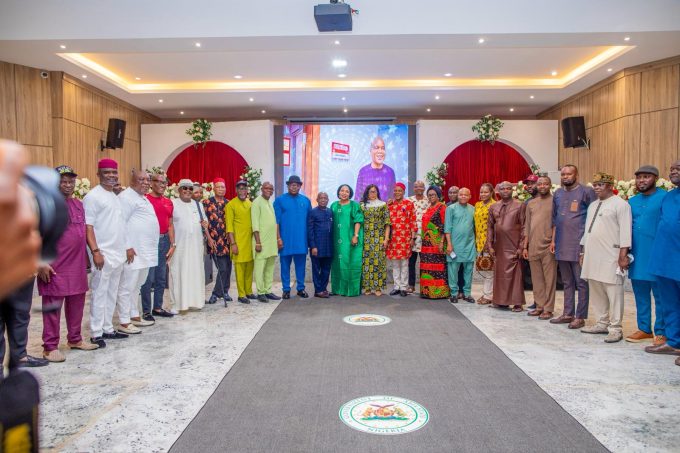
The European Union (EU) and its international partners have unveiled new measures to boost Nigeria’s digital transformation agenda as stakeholders gathered in Kano for the fifth Project Steering Committee meeting of the Digital Transformation Centre Nigeria. The event also featured the launch of the Women Venture Studio Innovation Hub.
The programme, funded by the EU, Germany’s Federal Ministry for Economic Cooperation and Development (BMZ), and the Kingdom of Denmark, and implemented by GIZ Nigeria, brought together representatives from government agencies, universities and the country’s innovation ecosystem. The meeting marked a major step toward expanding digital development efforts across more regions.
The EU’s Head of Section for Green and Digital Economy, Inga Stefanowicz, emphasised the need to ensure that digital development remains a nationwide conversation.
“We do not want this Steering Committee to remain only in Abuja,” she said. “We have taken it across the country, from Lagos to Ibadan and now Kano, because digital transformation is happening in the north as well as other parts of Nigeria.”
She noted that the initiative is part of an EU digital cooperation package worth €820 million. By 2025, an additional €45 million will fund ICT training through the 3MTT programme, expand national fibre-optic connectivity and support digital public infrastructure.
“It has been three years of implementation. This was only the first step, and there is still more to be done,” she added.
Since its launch, the Digital Transformation Centre has trained and supported more than 5,300 Nigerians, among them 2,060 women and 795 persons with disabilities. Participants have benefited from digital skills development, start-up support and entrepreneurship resources.
The programme is also testing digital vouchers to help individuals and businesses access essential technology. In addition, 40 start-ups and MSMEs have received innovation support, while policy efforts in four states are helping to close the digital gender gap.
Speaking on behalf of the Director-General of NITDA, Acting Director of Digital Literacy and Capacity Building, Dr. Ahmed Yusuf Tambuwal, said the discussions were both strategic and forward-looking.
“We are here to review progress and chart the next steps. We have identified gaps and aligned our priorities. Our commitment to inclusion remains strong. We want a digital economy that works for everyone, especially women and persons with disabilities,” he said.
From the academic sector, Dr. Victor Odumiuwa of the NITDA IT Hub highlighted the programme’s impact on universities.
“Many start-ups have been supported, and many trainings have taken place. This is helping us scale innovation within Nigerian universities,” he said.
For the next phase, stakeholders agreed on several key goals, including training an additional 5,800 young people, expanding green and digital skills programmes, strengthening ICT employability opportunities and scaling initiatives such as mentorship, job-market integration and digital vouchers.

Business
 News MasterUpdated 3 months Ago2 Mins read
EU, Partners Advance Nigeria’s Next Phase of Digital Transformation
News MasterUpdated 3 months Ago2 Mins read

Share





Related Articles
Business
Power Flow Restored as Shiroro–Mando Transmission Line Returns to Service
The Transmission Company of Nigeria (TCN) has restored a crucial section of...

Business
Nigerian Engineer Wendy Okolo Honoured for Pioneering NASA Safety Research
The United States diplomatic mission in Nigeria has recognised the achievements of...

Business
Customs Transfers Nearly 160,000 Litres of Confiscated Petrol to Regulatory Authority
A large volume of petrol intercepted during anti-smuggling operations has been formally...

Business
Music Rights Body Accuses Malami of Orchestrating Billion-Naira Levy Scam
The Copyright Society of Nigeria (COSON) has voiced serious concerns over what...




Leave a comment