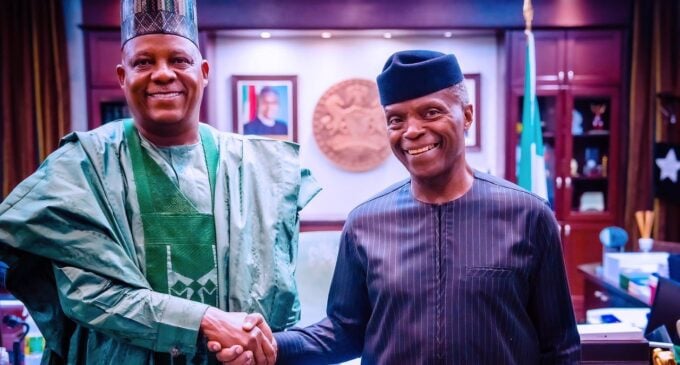
Former Vice President Yemi Osinbajo has warned that Africa’s economic growth will remain superficial unless it is founded on social justice that prioritises the well-being of its citizens.
Speaking at the 65th anniversary celebration of the Ford Foundation in Abuja, where he delivered a keynote address titled “Social Justice as an Imperative to Development,” Osinbajo said Gross Domestic Product (GDP) figures alone do not equate to real progress when large sections of the population remain poor and excluded.
“Africa has been the fastest-growing continent in terms of GDP for some time, yet it ranks lowest in overall quality of life when assessed through indicators such as health, education, infrastructure, and economic stability,” he said.
He added, “GDP growth does not automatically mean development. It does not necessarily translate into jobs or a decent life for citizens. For many, the promise of democracy has not resulted in a better standard of living.”
Recalling his time as head of Nigeria’s Economic Management Team (2016–2019), Osinbajo noted his frustration that many citizens felt disconnected from official claims of economic success.
“People often asked, ‘Which country are you people talking about? I can’t pay my children’s school fees or hospital bills.’ It became clear that when government talks about growth, citizens don’t always see themselves in that narrative,” he said.
Osinbajo emphasised that true development must be anchored on fairness and equality. “We shouldn’t talk about development unless it directly improves the welfare of the majority of our people,” he stressed.
He described social justice as “fair access to opportunities, protection of rights, and the resources necessary to live a dignified and productive life,” adding that good governance, financial inclusion, and anti-corruption efforts are central to achieving it.
“Corruption—both public and private—is a major obstacle to social justice,” he noted, citing a PricewaterhouseCoopers report warning that unchecked corruption could cost Nigeria 37 per cent of its GDP by 2030.
Vice President Kashim Shettima, represented by Zahra Audu, Director-General of the Presidential Enabling Business Environment Council (PEBEC), also addressed the gathering, describing social justice as both a moral and economic necessity.
He said the Tinubu administration’s goal is to build “an economy that works for all, anchored on inclusion, equity, and empowerment,” adding that inequality weakens productivity, stifles innovation, and erodes trust in national institutions.
Shettima urged that fairness must be woven into the country’s institutional fabric so that development is not only reflected in statistics but also experienced by citizens.
Established in 1959, the Ford Foundation has supported various social justice, governance, and education projects across West Africa. Its 65th anniversary celebration comes amid growing national discussions on inequality, inclusive growth, and governance reforms under President Bola Tinubu’s administration.

Politics
 News MasterUpdated 11 months Ago2 Mins read
Osinbajo: Africa’s Growth Meaningless Without Social Justice and Citizens’ Welfare
News MasterUpdated 11 months Ago2 Mins read
Share



Related Articles

Politics
ORU WEST DESERVES BETTER, NO COMMUNITY WILL BE LEFT BEHIND — DCN OBIOMA OKORIE
Hon. Deacon Obioma Okorie, aspirant for Oru West State Constituency for the...
Politics
Abia’s Future in Focus: Mascot Uzor Kalu Emerges Voice of Reason Amid Abia APC Political Tension
“In the end, peace is not merely the absence of conflict, but...
Politics
Abia’s Future in Focus: Mascot Uzor Kalu Emerges Voice of Reason Amid Abia APC Political Tension
“In the end, peace is not merely the absence of conflict, but...
Politics
ADC Faces Crucial Test as Supreme Court Ruling Looms Over 2027 Ambitions
The African Democratic Congress (ADC) is at a defining crossroads as the...




Leave a comment