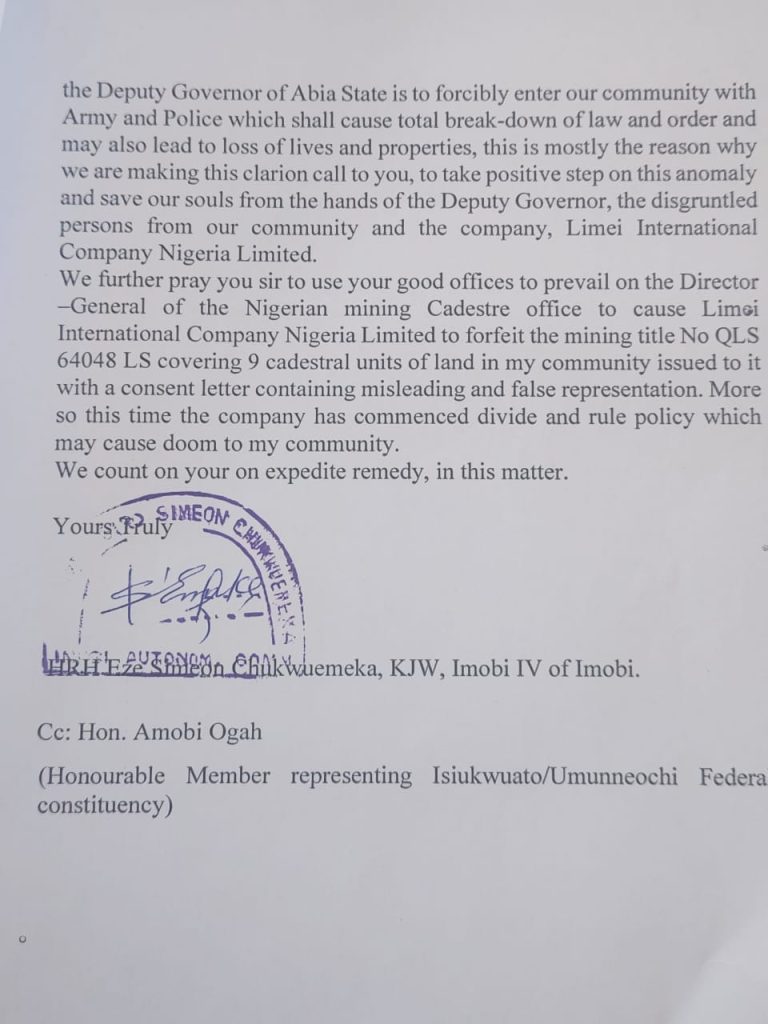


Hon. Amobi Godwin Ogah, the lawmaker representing Isuikwuato/Umunneochi Federal Constituency, has formally presented a petition from the Imobi Autonomous Community in Achara Uturu, Isuikwuato Local Government Area of Abia State before the House of Representatives, drawing federal attention to allegations of illegal mining and disputed land consent within the community.
Raising the issue during plenary at the National Assembly in Abuja, Ogah urged relevant federal authorities to urgently intervene and thoroughly investigate the claims made by the community, warning that the matter could escalate into a serious security concern if not promptly addressed.
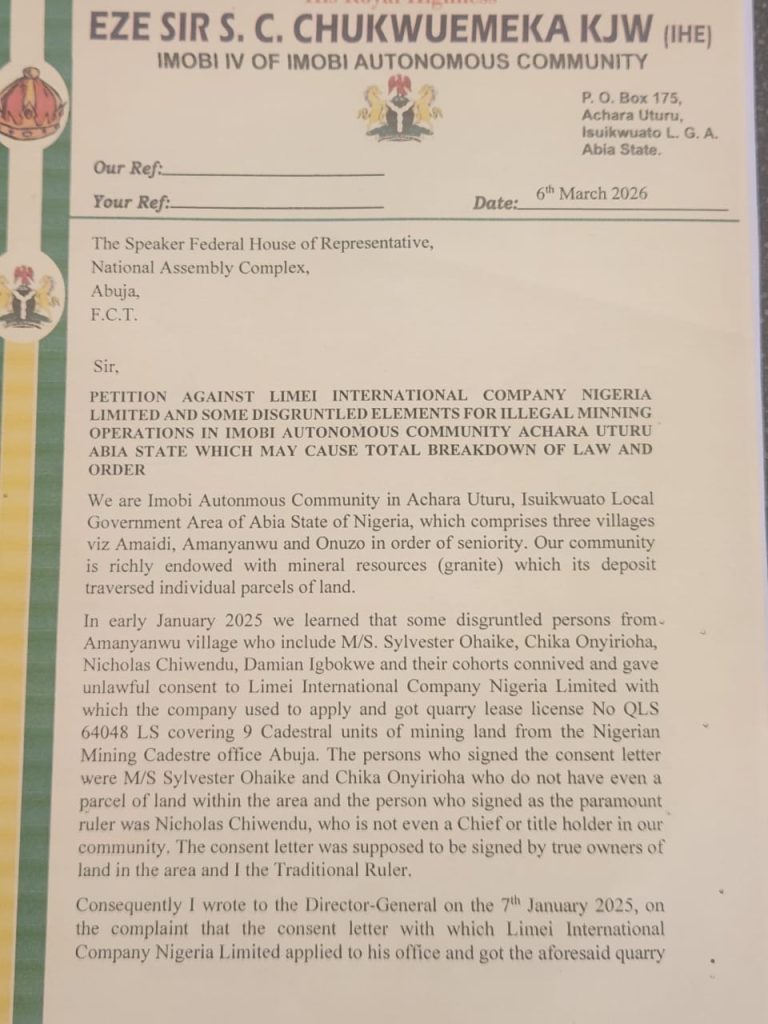
The petition, endorsed by the traditional ruler of the community, Eze Sir S. C. Chukwuemeka (Imobi IV), accused some individuals of allegedly facilitating unauthorized mining arrangements involving Limei International Company Nigeria Limited without the approval of legitimate landowners.
According to the petitioners, certain individuals from Amanyanwu village purportedly issued a consent letter that enabled the company to secure a quarry lease licence (No. QLS 64048 LS) from the Nigerian Mining Cadastre Office in Abuja.
However, community leaders contend that the individuals who reportedly endorsed the consent letter are neither the rightful custodians nor recognized owners of the land designated for the quarry project, thereby rendering the authorization questionable and procedurally defective.
The petition further alleged that Mr. Nicholas Chiwendu misrepresented himself as a paramount ruler while signing documents associated with the mining consent, despite claims that he does not hold any recognised traditional title or leadership position within the Imobi Autonomous Community.
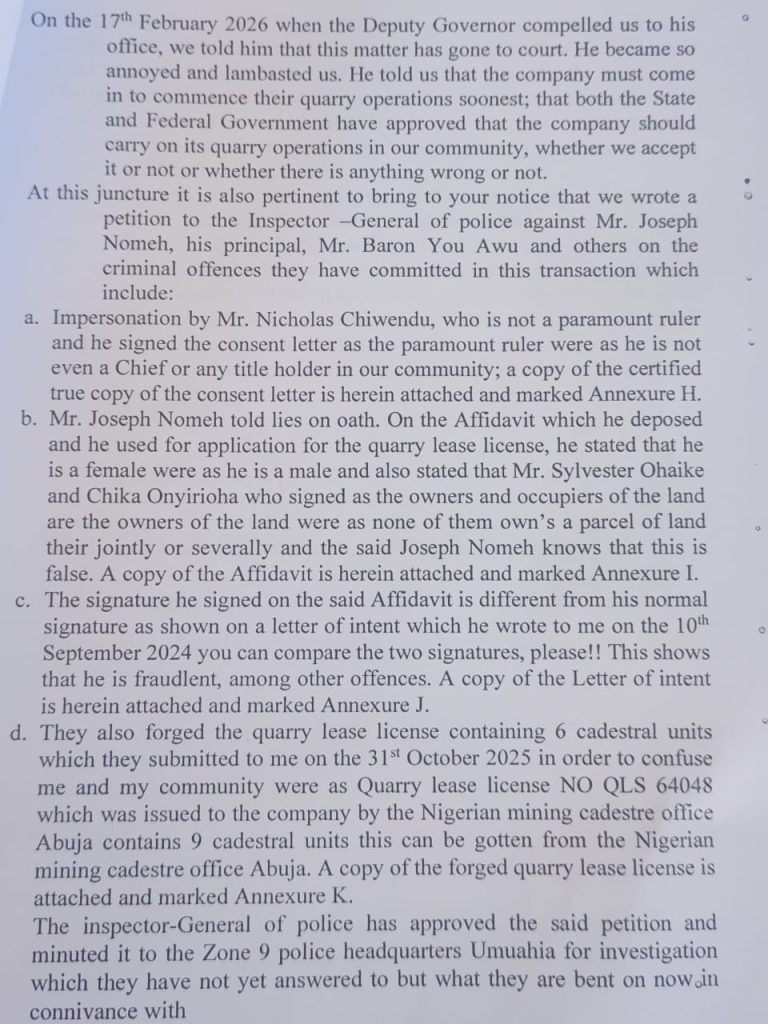
Beyond the dispute over land ownership, the community also raised concerns about what it described as significant procedural irregularities surrounding the approval of the quarry licence. These alleged infractions include impersonation, false declarations under oath, misrepresentation of land ownership status, and the suspected forgery of official documentation used in securing the mining permit.
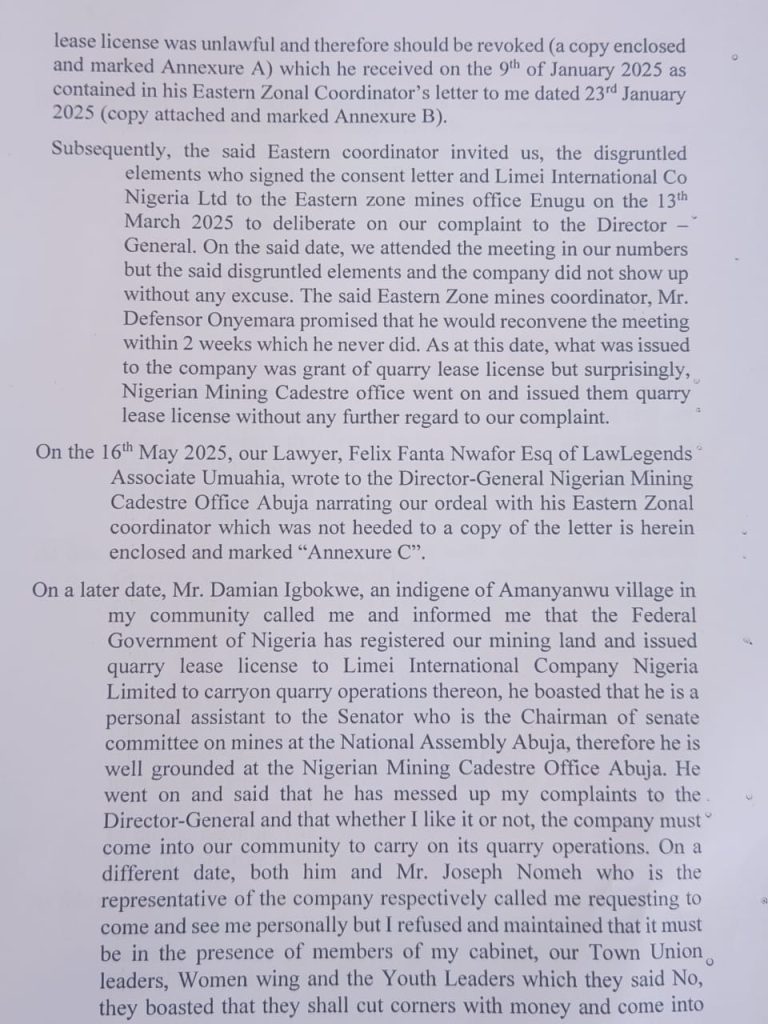
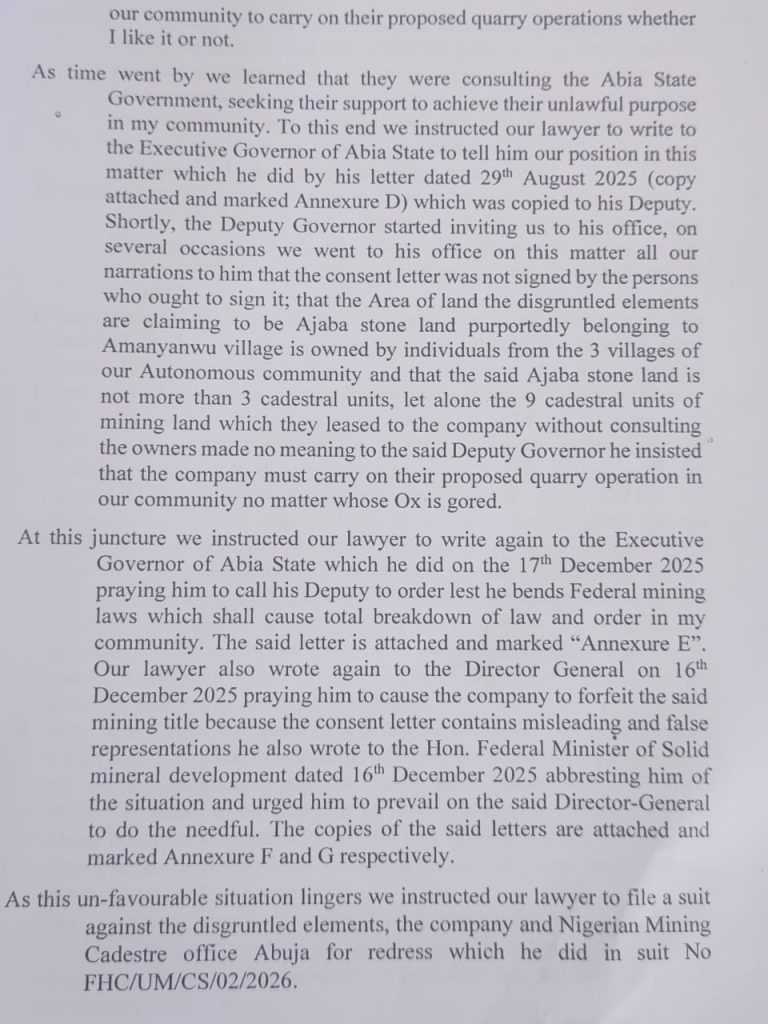
Community leaders disclosed that the matter has already been subjected to judicial scrutiny, with a suit currently before the Federal High Court under case number FHC/UM/CS/02/2026. The case reportedly involves the individuals accused of granting the consent, Limei International Company Nigeria Limited, and the Nigerian Mining Cadastre Office.
In addition to the court proceedings, the community confirmed that a separate petition detailing the alleged criminal elements of the case has been submitted to the Inspector-General of Police. The complaint has since been referred to the Zone 9 Police Headquarters in Umuahia for further investigation.
The community leadership also expressed unease over what it described as attempts by certain authorities to pressure the community into allowing the mining company to commence quarry operations despite the pending legal and investigative processes.
Eze Chukwuemeka explained that the disputed land forms part of a mineral-rich belt jointly shared by three villages within the Imobi Autonomous Community — Amaidi, Amanyanwu and Onuzo — and comprises parcels owned by multiple families and individuals whose consent, according to the petition, was never formally obtained.
While reiterating that the community welcomes legitimate investment and responsible development, the traditional ruler stressed that any exploitation of local natural resources must strictly adhere to due process and respect the rights and consent of lawful landowners.
Consequently, the Imobi Autonomous Community called on the National Assembly, the Federal Ministry of Solid Minerals Development, security agencies and other relevant government institutions to conduct a transparent investigation into the circumstances surrounding the issuance of the quarry lease licence.
The community also appealed to the Federal Government to uphold justice, equity and the rule of law, cautioning that neglecting the concerns of the rightful landowners could aggravate tensions and undermine peace within the area.
Despite the ongoing dispute, community leaders reaffirmed their commitment to resolving the matter through lawful and peaceful means, while urging authorities to act decisively to prevent further escalation.