The crisis rocking the Peoples Democratic Party (PDP) has intensified, with more prominent members exiting the party while rival factions escalate their struggle for control, now heading toward the Supreme Court for final resolution.
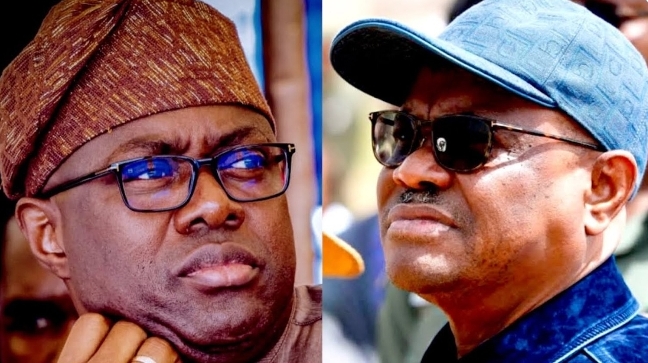
Despite the conduct of a recent national convention and recognition of a new National Working Committee (NWC) by the Independent National Electoral Commission (INEC), the legitimacy of the exercise remains highly contested. The convention, reportedly backed by allies of the Minister of the Federal Capital Territory, Nyesom Wike, is being challenged in court by a rival bloc aligned with Governors Seyi Makinde of Oyo State and Bala Mohammed of Bauchi State.
The Makinde-backed faction has described the convention as unlawful, insisting that it violated ongoing court proceedings. In a statement issued by its National Publicity Secretary, Ini Ememobong, the group confirmed that it has approached the judiciary up to the Supreme Court to seek a definitive ruling on the party’s leadership dispute.
The faction accused the Wike-aligned group of proceeding with the convention in disregard of an existing Court of Appeal matter in Ibadan, arguing that agreed legal procedures were ignored.
Tensions escalated further following a Federal High Court ruling in Abuja, which granted the Wike-backed faction access to the PDP national secretariat at Wadata Plaza. Justice Joyce Abdulmalik also ordered security agencies to provide protection for the faction while occupying the premises.
The court, in its judgment, invalidated a previous convention organized by the Turaki-led faction in Ibadan in November 2025, describing it as unconstitutional and conducted in violation of court orders. The ruling also nullified the expulsion of Wike and his associates, stating that such actions contravened due process.
The suit was filed by members aligned with the Wike camp, who had sought restrictions preventing the rival faction from accessing the party headquarters and from being recognized by INEC as the legitimate leadership.
In response, the Turaki faction has vowed to challenge the judgment, directing its legal team to file an appeal and pursue further judicial remedies.
Meanwhile, INEC’s recent update of its official website recognizing the newly constituted NWC, led by Mohammed as National Chairman and Senator Samuel Anyanwu as National Secretary, has added another layer to the controversy. The development is widely seen as strengthening the Wike-backed faction’s position within the party.
However, the recognition has drawn sharp criticism from senior PDP figures. Former Deputy National Chairman, Bode George, condemned INEC’s action, describing it as misleading and a threat to democratic stability. He maintained that the Wike-aligned group had been expelled and represents only a minority within the party, warning that the commission’s stance could have broader implications for Nigeria’s political landscape.
George urged party members to remain patient and await the Supreme Court’s verdict, expressing confidence that the judiciary would ultimately resolve the dispute in line with justice.
Amid the internal turmoil, defections from the PDP continue to grow. Isa Ashiru, the party’s governorship candidate in Kaduna State during the 2023 elections, has officially resigned his membership and indicated a move to the African Democratic Congress (ADC). Similarly, former Minister of State for the Federal Capital Territory, Jumoke Akinjide, has also exited the party after more than two decades of affiliation, though she has not disclosed her next political destination.
Former Ekiti State Governor, Ayodele Fayose, reacted strongly to the unfolding developments, warning that Governor Makinde risks expulsion from the party over his role in the ongoing factional dispute. He maintained that the recent convention marked a turning point for the PDP and insisted that the party would move forward without dissenting elements.
Despite the deepening divisions, some party stakeholders remain hopeful. Presidential aspirant Gbenga Hashim emphasized that reconciliation is still possible if party leaders return to dialogue. He cautioned that continued fragmentation could weaken the PDP’s ability to function as a viable opposition ahead of future elections.
Hashim urged all factions to embrace compromise and align with previous agreements, noting that existing legal processes at the Court of Appeal and Supreme Court provide avenues for resolving the leadership crisis.
As legal battles continue and defections mount, the PDP faces one of the most significant internal challenges in its recent history, with the outcome likely to shape its structure and political relevance in the coming years.

Politics
 News MasterUpdated 7 months Ago3 Mins read
PDP Crisis Deepens as Defections Mount, Makinde Camp Heads to Supreme Court Over Leadership Battle
News MasterUpdated 7 months Ago3 Mins read
Share



Related Articles
Politics
ORU WEST DESERVES BETTER, NO COMMUNITY WILL BE LEFT BEHIND — DCN OBIOMA OKORIE
Hon. Deacon Obioma Okorie, aspirant for Oru West State Constituency for the...
Politics
Abia’s Future in Focus: Mascot Uzor Kalu Emerges Voice of Reason Amid Abia APC Political Tension
“In the end, peace is not merely the absence of conflict, but...
Politics
Abia’s Future in Focus: Mascot Uzor Kalu Emerges Voice of Reason Amid Abia APC Political Tension
“In the end, peace is not merely the absence of conflict, but...
Politics
ADC Faces Crucial Test as Supreme Court Ruling Looms Over 2027 Ambitions
The African Democratic Congress (ADC) is at a defining crossroads as the...



Leave a comment