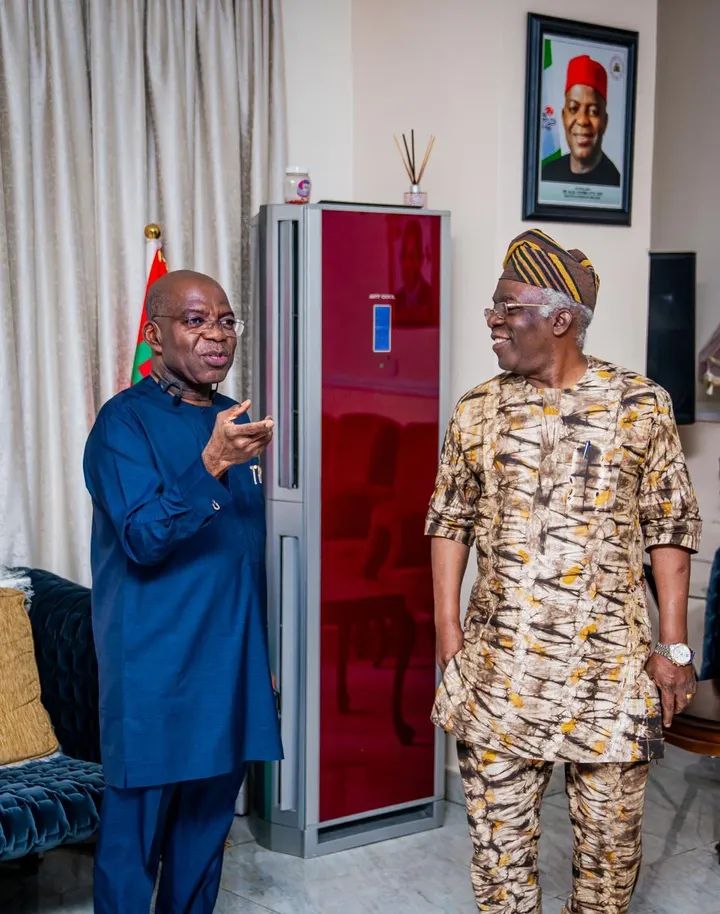
Renowned human rights lawyer, Femi Falana (SAN), has commended Abia State Governor, Dr. Alex Otti, for his impressive developmental achievements in just over two years in office.
Falana made the remarks on Wednesday, October 8, during a courtesy visit to Governor Otti at his office in Umuahia. The Lagos-based legal luminary was in Abia State in connection with a court case.
Speaking to journalists after the meeting, Falana said he has been closely acquainted with the affairs of Abia since 1999 and noted significant improvements in infrastructure and governance under Otti’s leadership.
“I’ve been visiting Abia since the return to civilian rule in 1999, and I can say without fear of contradiction that I’ve seen real signs of good governance that were absent before,” Falana said. “I’ve toured the state and observed good roads, schools, and hospitals. These are clear indicators of physical development. From my interactions with residents, their feedback has also been very positive.”
Falana urged Governor Otti to sustain his people-oriented policies, stressing that the government must always place citizens at the centre of its development agenda to deliver the true dividends of democracy.
Commenting on the continued detention of IPOB leader, Mazi Nnamdi Kanu, the Senior Advocate of Nigeria described the matter as a political issue that should be resolved outside the courts.
“I won’t comment on pending proceedings, but I believe this is a political case that requires a political solution,” Falana said. “If the government can negotiate with bandits and other criminal elements, there’s no justification for not resolving this matter politically.”
On the state of Nigeria’s judiciary, Falana expressed concern over limited access to justice for ordinary citizens, arguing that the current system primarily serves politicians and elites.
“Only political cases move quickly in our courts because they are time-bound. The common man, however, lacks the means to seek justice. The judiciary today is the last hope of the elite, not the common man,” he lamented.
He advocated for greater promotion of alternative dispute resolution and reforms of traditional justice systems, emphasizing that most Nigerians rely on community leaders and customary courts to settle disputes.
“If people trust their traditional rulers to dispense justice, government should strengthen those institutions,” he said. “It’s not enough to build a justice system that caters only to the elite.”

Politics
 News MasterUpdated 12 months Ago1 Mins read
Femi Falana Applauds Gov. Otti’s Development Strides, Urges Political Resolution of Nnamdi Kanu’s Case
News MasterUpdated 12 months Ago1 Mins read
Share





Related Articles

Politics
ORU WEST DESERVES BETTER, NO COMMUNITY WILL BE LEFT BEHIND — DCN OBIOMA OKORIE
Hon. Deacon Obioma Okorie, aspirant for Oru West State Constituency for the...
Politics
Abia’s Future in Focus: Mascot Uzor Kalu Emerges Voice of Reason Amid Abia APC Political Tension
“In the end, peace is not merely the absence of conflict, but...
Politics
Abia’s Future in Focus: Mascot Uzor Kalu Emerges Voice of Reason Amid Abia APC Political Tension
“In the end, peace is not merely the absence of conflict, but...

Politics
ADC Faces Crucial Test as Supreme Court Ruling Looms Over 2027 Ambitions
The African Democratic Congress (ADC) is at a defining crossroads as the...




Leave a comment