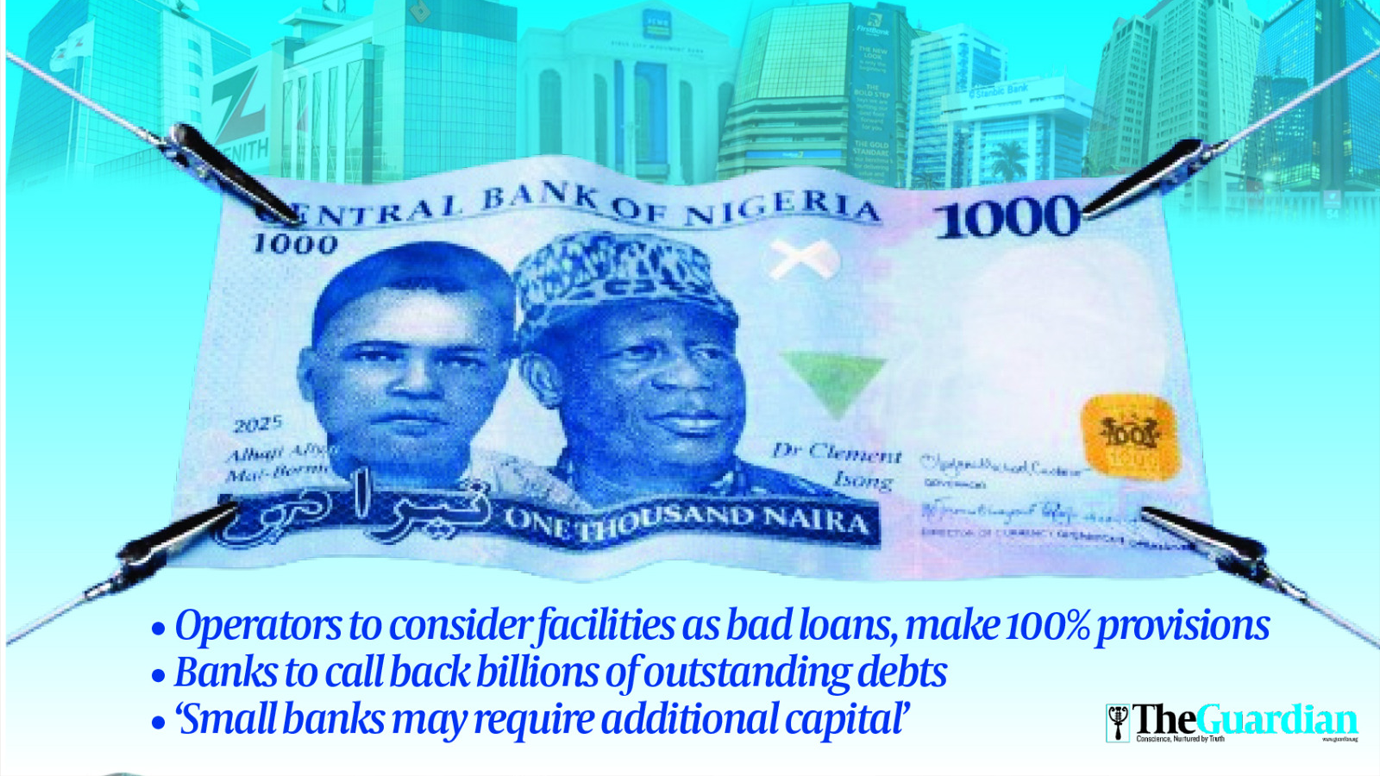
The Central Bank of Nigeria (CBN) has introduced stricter measures to tackle insider lending in the banking sector, a move that could affect dividend payments to shareholders in the coming years.
Under the new directive, banks are required to classify insider-related loans as non-performing and make 100 per cent provisions for such facilities within an 18-month period, beginning at the end of April 2026. The policy is aimed at strengthening asset quality and reducing the risks associated with loans granted to bank insiders.
Industry sources say the regulation could force several banks to make fresh impairment provisions worth billions of naira, which may limit their ability to declare dividends for shareholders over the next two years.
Reports indicate that insider lending accounts for more than 30 per cent of total loans in some banks, though analysts warn that the actual figures may be higher due to poor disclosure and transparency in financial reports.
The apex bank believes that under difficult economic conditions, many of these loans could become unrecoverable because they are often poorly secured. This concern has prompted the new prudential rules designed to compel banks to strengthen their risk management practices.
Earlier, the CBN ended a long period of regulatory forbearance, forcing banks to make large provisions in their 2025 financial statements, which in some cases resulted in significant losses.
The latest directive comes just weeks before the March 31 deadline for the ongoing banking sector recapitalisation, through which banks are reported to have raised over N4 trillion. According to the CBN, 30 banks have already met the recapitalisation requirement, easing fears of possible liquidation within the industry.
However, the regulator is said to remain concerned about the quality of assets held by several banks, with insider lending abuses emerging as a major risk to financial stability.
The CBN has also instructed banks to conduct stress tests on their operations starting April 1. The exercise will assess how resilient banks’ loan portfolios are under severe economic conditions, such as currency fluctuations, falling commodity prices, and changes in industry dynamics.
Banks are expected to simulate scenarios where asset quality deteriorates and governance risks increase. As part of the exercise, insider and politically exposed loans will be treated as if they have defaulted under severe stress conditions.
Experts say the directive is designed to prevent a repeat of the post-2005 banking crisis, when excessive insider lending contributed to a sharp rise in non-performing loans and led to the creation of the Asset Management Corporation of Nigeria (AMCON) to absorb toxic assets from struggling banks.
Although the industry’s current non-performing loan ratio stands at about seven per cent, slightly above the regulatory threshold of five per cent, analysts warn that the real figures may be higher due to possible manipulation of loan performance data.
Economist Godwin Owoh praised the move, saying stricter oversight of insider lending is necessary to protect shareholders from the consequences of weak corporate governance.
Similarly, Chiwuike Uba, a professor of economics, described the stress test as a precautionary measure to ensure banks remain stable during economic shocks such as recessions or currency volatility.
He noted that while stronger banks may withstand the new requirements, mid-tier or smaller banks with higher risk exposure could be forced to raise additional capital through equity offerings, rights issues, or mergers.
Under the CBN’s guidelines, banks that experience capital shortfalls after the stress tests will be required to raise 100 per cent of the shortfall, or at least 50 per cent of the deficit calculated by the CBN, within 18 months.
The regulator believes the measures will strengthen governance, improve risk management, and ensure the banking sector remains resilient against future economic challenges.

Business
 News MasterUpdated 7 months Ago2 Mins read
Shareholders May Lose Dividends as CBN Moves to Curb Insider Lending Abuse
News MasterUpdated 7 months Ago2 Mins read
Share






Related Articles

Business
Hon. Amobi Ogah Engages Global Stakeholders at OTC Texas As Nigeria’s Energy Future Comes in Focus
U.S., Texas — Nigeria’s push for innovation and global collaboration in the...

Business
Fear of Oil Glut as NNPCL Raises Crude Prices Across Grades
Concerns are growing over a possible global oil glut as the Nigerian...
Business
Aliko Dangote’s Wealth Climbs to $34bn After $216m Single-Day Surge
Africa’s richest man, Aliko Dangote, has seen his net worth rise to...

Business
Nigeria’s Petrol Price Drops 15.6% Year-on-Year – NBS
The average retail price of petrol in Nigeria declined by 15.6 per...




Leave a comment