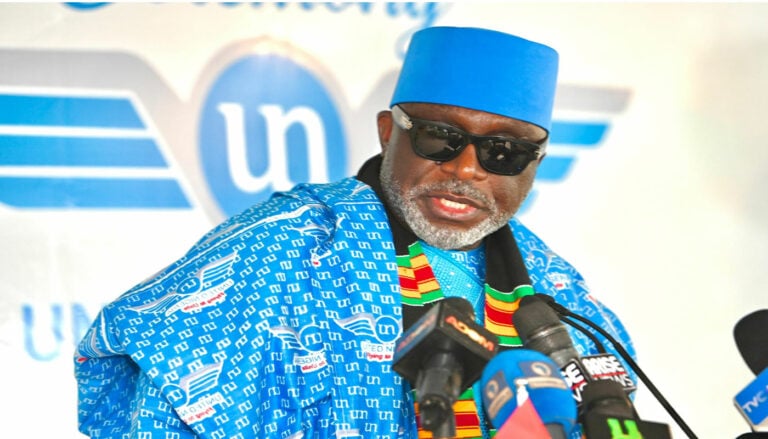
United Nigeria Airlines Chairman and CEO, Obiora Okonkwo, has highlighted key challenges confronting Nigeria’s aviation industry, including policy constraints, infrastructure gaps, and the strain of multiple taxes. Speaking on developments within the sector, he explained how these issues continue to hinder domestic operators and affect their ability to grow regionally, especially as the airline launches its new Accra route.
Addressing what sets the airline apart on the Lagos–Accra service, Okonkwo said United Nigeria Airlines is prioritising visibility, competitive pricing, and exceptional service. He noted that the CRJ-900 aircraft deployed on the route offers a strong advantage in comfort and capacity, while the airline’s 98% on-time performance—built from domestic experience—will be extended to regional operations. With nearly half of West Africa’s air traffic concentrated between Nigeria and Accra, he believes the market remains highly competitive and viable for expansion.
Okonkwo, however, expressed deep concern over the heavy tax burden on Nigerian carriers, citing the $80 FAAN charge, $20 NCAA levy, and a 5% ticket sales tax as major obstacles. He argued that these fees significantly inflate ticket prices, leaving airlines with little or no profit margin and pushing passengers away from air travel. According to him, such policies weaken local operators while enabling foreign airlines to dominate regional routes, resulting in capital flight.
He further stressed that access to affordable financing remains a critical barrier. Unlike foreign competitors who secure loans at interest rates as low as 2–3%, Nigerian airlines must borrow at rates above 30%, making operations far more expensive. Okonkwo urged the government to treat aviation as an essential economic driver, similar to agriculture, and to introduce supportive policies that would help operators grow, acquire more aircraft, and contribute meaningfully to national development. Without such reforms, he warned, high taxes and prohibitive financing costs will undermine the industry despite government intentions to improve the sector.
Business
 News MasterUpdated 10 months Ago1 Mins read
United Nigeria Airlines Chief Warns High Taxes Threaten Regional Expansion
News MasterUpdated 10 months Ago1 Mins read
Share



Related Articles

Business
Hon. Amobi Ogah Engages Global Stakeholders at OTC Texas As Nigeria’s Energy Future Comes in Focus
U.S., Texas — Nigeria’s push for innovation and global collaboration in the...
Business
Fear of Oil Glut as NNPCL Raises Crude Prices Across Grades
Concerns are growing over a possible global oil glut as the Nigerian...
Business
Aliko Dangote’s Wealth Climbs to $34bn After $216m Single-Day Surge
Africa’s richest man, Aliko Dangote, has seen his net worth rise to...
Business
Nigeria’s Petrol Price Drops 15.6% Year-on-Year – NBS
The average retail price of petrol in Nigeria declined by 15.6 per...




Leave a comment